Download

1 / 13
130 likes | 253 Vues
Matter is defined as anything that has mass and occupies space, composed of atoms, elements, and compounds. It exists in four primary states: solid, liquid, gas, and plasma, each with distinct characteristics. Solids have a definite shape and volume, liquids have a definite volume but adopt the shape of their container, gases have neither definitive shape nor volume, and plasma is an ionized gas with charged particles. Furthermore, matter undergoes phase changes such as melting, boiling, condensation, freezing, sublimation, and deposition, which are influenced by energy levels.

E N D
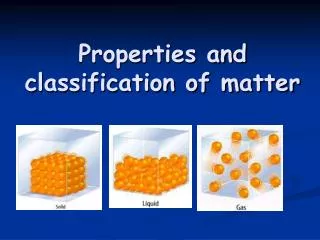
Matter: • Anything that has mass and takes up space Matter is made up of building blocks: atom – smallest unit of an element. element – a pure substance made of only one kind of atom. compound – made of two or more atoms that are chemically combined.
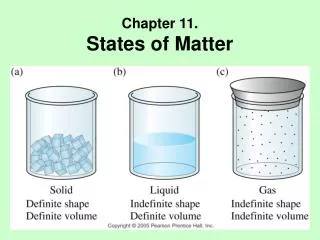
States of Matter • Solid- • Definite volume and shape • Particles are tightly packed • Slight expansion when heated • Incompressible
Liquid- • Has definite volume, but no definite shape (assumes the shape of the container) • Particles are loosely packed (can flow) • Easily expand when heated • Considered incompressible
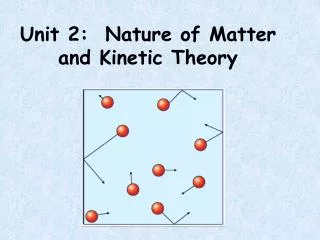
Gas- • No definite shape or volume • Expands to fill the container • Particles are spaced far apart • Compressible
Plasma- • Consists of electrically charged particles • It’s an ionized gas • Common in space, but very rare on Earth • Found in lightning, fluorescent lights and neon signs
Gas Liquid Solid Plasma
Energy Amounts in States of Matter • Solid- little energy, particles vibrate and rotate • Liquid- more energy, they move freely • Gas- even more energy, move quickly • Plasma- most energy, move extremely fast
Names of Phase Changes • Solid to Liquid = Melting • Liquid to Gas = Boiling/evaporation • Gas to Liquid = Condensation • Liquid to Solid = Freezing • Solid to Gas = Sublimation • Gas to Solid = Deposition
States of Matter a.k.a. Phases of Matter Gas Energy Liquid Solid
Properties of Matter • 2 Types: • Extensive – depends on the amount of the sample • Examples = volume mass length weight
Properties of Matter (cont.) • Intensive – does not depend on the amount of the sample • Examples = density melting point boiling point malleability ductility color odor