Download
1 / 39
420 likes | 587 Vues
Sedimentary rocks are formed from the accumulation and lithification of sediments deposited by water, wind, ice, or chemical processes. This guide explores the processes of weathering, erosion, transport, and deposition that lead to sediment formation. It also examines the types of sedimentary rocks, including clastic, chemical, and organic varieties, and highlights features such as bedding and fossils that provide insights into their history. Understanding these processes and classifications can enhance our knowledge of Earth's geological history and the fossil record found within these rocks.

E N D
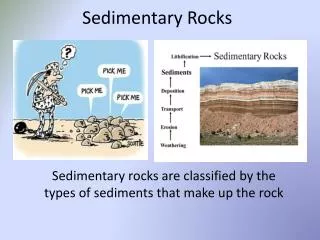
Sedimentary Rocks • Related word = “sediment” • Sediment - pieces of solid material that have been deposited on earth’s surface by water, wind, ice, gravity or chemical precipitation
Sedimentary Rocks • Related word = “sediment” • Sediment - pieces of solid material that have been deposited on earth’s surface by water, wind, ice, gravity or chemical precipitation
Weathering • a set of physical and chemical processes that break rock into smaller pieces • Chemical weathering - • When minerals in a rock are dissolved and the rock is changed chemically • Physical weathering - • Minerals remain unchanged • Simply break into small pieces
Clastic Sediments • Produced by weathering
Erosion and Transport • The removal and movement of surface materials from one location to another • Carried by wind, water, ice and gravity • Materials usually move downhill
Deposition • When materials are laid down on the ground or sink to the bottom of bodies of water • When transport stops, materials are deposited • Generally, largest particles settle out first and produce sorted layers • Glacier and landslide deposits not sorted
Burial • When materials are deposited in basins, other sediments are deposited on top if them. • This leads to the layered appearance that some sedimentary rocks exhibit
Lithification • Litho?
Lithification • Litho? • Lithification - the physical and chemical processes that transform sediments into sedimentary rocks Compaction Cementation Lithification
Lithification • Compaction? (Similar words?) • Compaction - clasts (?) are squeezed together. Water is squeezed out.
Lithification • Cementation? (Similar words?) • Cementation - mineral growth in spaces between clasts cements clasts together • Two methods:
Features of Sedimentary Rocks • Bedding - visible horizontal layers in the rock • Beds can be millimeters thick or meters thick • Type of bedding depends upon the method of transport. • Size of grains depend on many factors
Graded Bedding • Particle size is bigger and coarser at the bottom of the beds • Underwater landslides, fast-moving streams
Cross-Bedding • Formed as inclined layers of sediment move forward across a horizontal surface • Sand dunes, beaches, lake edges
Cross-Bedding • Formed as inclined layers of sediment move forward across a horizontal surface • Sand dunes, beaches, lake edges
Evidence of Past Life • Fossils - preserved remains, impressions or any other evidence of once-living organisms (Why not in igneous?)
Fossils and Sedimentary Rocks • Fossilscan help ID the rocks, and vice-versa! • Types of fossils found give a clue about the rock’s origin- fossils of marine animals indicate ……
Fossils and Sedimentary Rocks • Fossilscan help ID the rocks, and vice-versa! • Types of fossils found give a clue about the rock’s origin- fossils of marine animals indicate …… • The rock formed from sediments deposited near (or in) the sea.
Clastic Sedimentary Rocks • Coarse-Grained Clastics Conglomerate Breccia
Clastic Sedimentary Rocks • Grain Shape - Influenced by: • Distance of transport - The further it travels, the rounder it becomes • Length of time of transport- The longer it’s affected by water, wind or ice, the rounder it becomes
Clastic Sedimentary Rocks • Medium-Grained Clastics - (Sandstone) sometimes contain oil, natural gas and groundwater • Porosity: percentage of open space between grains
Clastic Sedimentary Rocks • Fine-grained Clastics (Shale) • Has low porosity that hinders movement of oil, water and natural gas
Chemical Sedimentary Rocks • Formed from the evaporation of saturated liquids • Called evaporites
Organic Sedimentary Rocks • Biogenic - (bio = ?; genic = ?)
Organic Sedimentary Rocks • Biogenic - (bio = ?; genic = ?) • Formed from the remains of once-living things - limestone • Organisms use calcium carbonate in their shells and skeletons • When they die, they sink to the bottom. • Calcium carbonate precipitates into the water the cements the grains of carbonate sediment.
Organic Sedimentary Rocks • Biogenic - (bio = ?; genic = ?) • Formed from the remains of once-living plants - coal • Plants in swamps and coastal areas die are buried and compressed. • Lithified into coal • Why is it called a Fossil fuel?