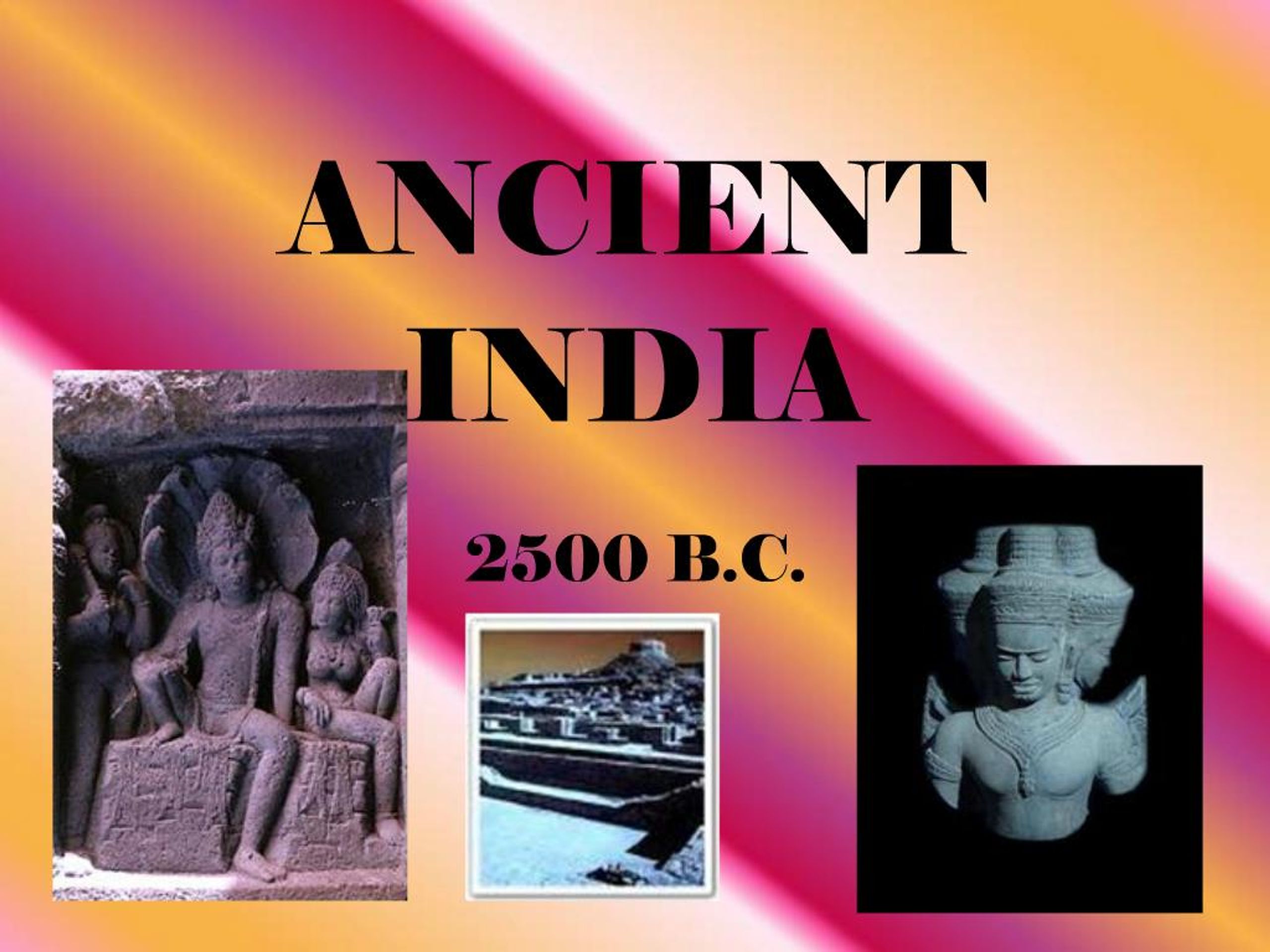
1. ANCIENT INDIA 2500 B.C.
2. Things You Need To Know About Ancient India About the river system and the physical setting
About the Aryan invasions
About Hinduism and Brahmanism
About the caste system
About Buddha
About the Maurya empire
About Emperor Asoka
3. Ancient India Geography India is a subcontinent, separated by the rest of the continent by the Himalayas. India can be divided in two, the northern plains, a flat low plain and the Deccan, a land with many hills. Up in northwest India is the Thar Desert. The Himalayas provided natural protection from northern invasions. The Indian Ocean and the Arabian Sea provided protection for the west and the east.
4. The River System The main river in Ancient India was the Indus River. The Indus River deposited fertile soil during annual flooding. The source of the Indus River is in the Himalayas.
5. The Aryan Invasions At about 1500 BC the Aryans began to migrate into India from the dry plains near the black sea. Nobody really knew who they were, their name meant noble, but scientists believe that they were warriors and herders. They also do not know why they left their homeland, but it may have been because of overpopulation. They moved into Mesopotamia, then across Persia, and then decided to settle on the Punjab plain which is now in Pakistan. At first they were herders but over time they adapted into farmers and became more and more like the Indian people.
6. The Maurya Empire Chandugragupta Maurya ordered land to be cleared and swamps drained to help out farmers, he improved the roads, and he did this by using taxes. This helped out the richer people but the common people suffered, because they could not pay them. He was very mean, but this helped him expand his empire, this made the overworked and overtaxed people thought of him as a cruel man. Knowing that people hated him, he feared he was in danger, and he was very cautious, he slept in different rooms each night, and he had his servants taste his food first for poison. He had a grandchild who became one of the greatest rulers of India, his name was Asoka.
7. Emperor Asoka As a young ruler he was very cruel, but after he conquered Kalinga in 261 BC his life changed, he began to hate violence and he became a Buddhist. He then made Buddhism the state religion and built Buddhist temples and sent out missionaries. Asoka had commands carved into stone pillars and they were posted all across his empire. Some pillars still stand today.
8. The Caste System The Aryan society was divided into four classes, or varnas. The highest are Brahmans, priests, second is Kshatriyas, warriors, third is Vaishyas, farmers, merchants, and craftsmen, fourth, the lowest is Shudras, they are servants or slaves.
9. The Caste System cont. The cast system determined many things about how people live, it determines their job, what they eat, what they wear, where they live, and who they marry. People are born into their caste, and have it for life. The Indian legend is that the castes emerged from body parts of Purusha the first human being.
10. Hinduism Hinduism evolved from the Aryans beliefs and from those of the people of India. The most important deities, or gods, in Hinduism were Brahma, Vishnu, and Shiva. The most important thing in Hinduism is how you act to other living things and what you do. They believe that each living thing has a soul that is reincarnated into another thing. Dharma, religious duty, and Karma, actions, decide the new caste they are reincarnated into, if you do well at both
you move up and not so good you move
down.
11. Buddhism Buddhism was introduced Siddhartha Gautama, a prince who believed in Hinduism except if you are good and pure you no longer have to go through the cycle of reincarnation. These ideas eventually formed into Buddhism. One day Siddhartha went in the shade of a tree and meditated on the idea of suffering and once he found what he wanted, became Buddha.
12. Buddhism cont. Buddha spread his teachings to northern India with followers becoming monks. Each monk meditated for multiple hours every day. The first written versions of Buddha’s teachings were made around 200 and 100 BC. Buddha’s teachings were centered around the Four Noble Truths. #1 said that suffering is part of life. #2 says that wanting things is the root of suffering. #3 says becoming wise and not wanting things takes away suffering. #4 is a guide to living with the eightfold path.
13. Fun Facts! The city Harappa was rebuilt 6 times due to flooding
The game chess began in India
Ancient Indians invented the number system and zero
They used anesthesia
No slavery was known of
They were the first ones to calculate pi
It held the worlds first university
They came up with navigation