Download

1 / 18
180 likes | 309 Vues
The scientific method is a systematic way of exploring questions and conducting experiments. It consists of several essential parts: formulating a question or problem, conducting research, identifying variables, formulating a hypothesis, and detailing materials and procedures. The method emphasizes the importance of control, independent, and dependent variables for accurate results. Through data collection, analysis, and interpretation, scientists draw conclusions about their hypotheses, ultimately refining their understanding of the phenomena studied. Following this method ensures validity and accuracy in scientific experimentation.

E N D
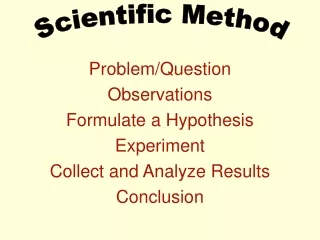
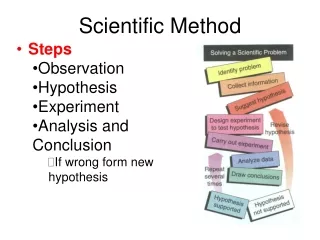
Basic Parts of Scientific Method • Question/Problem • Research • Variables • Hypothesis • Materials • Procedure • Data/Analysis • Conclusion
Question/Problem and Research • Purpose of performing the experiment, generally due to an observation • Must be a “scientific” question • Precise and based on an observation • Answered through research, experiments, observations • Research for background information • Find out what other scientists have discovered • May lead to a hypothesis
Variables • Any factor that can affect the outcome of an experiment • There are three types control, independent, and dependent variables • Control variables are the factors that are kept constant for the experimental and control group
Variables cont Independent variable • There can only be one for the experiment to be valid • It is the factor that you change • Sometimes called the manipulated variable • The experiment is designed around this variable • It is graphed on the x-axis • There is generally one but at times there may be more than one dependent variable • It is the factor that you are watching for • It is sometimes called the responding variable • It is graphed on the y-axis Dependent variables
Example of variables • Bob wonders how temperature affects the amount of salt that dissolves in water. From prior research, he believes that hot water will dissolve more salt. • Independent variable-temperature change • Dependent variable-amount of salt dissolved • Control variable-initial amount of salt, amount of water, size of beakers muppet.wikia.com
Groups • Control group is the group with the standard set-up, which is used for comparison • Experimental group is the group that has the standard set-up except the variable being tested is changed
Groups cont. • Bob wonders how temperature affects the amount of salt that dissolves in water. From prior research, he believes that hot water will dissolve more salt. • Control group-water at room temperature • Experimental groups-water at 40°C, 60°C, 80°C http://biologycorner.com/worksheets/controls.html http://sciencespot.net/Media/scimethodconvar.pdf 60°C 40°C 80°C www.clker.com
Hypothesis • Testable solution to the question/problem • Can be written as an if…then statement which involves using the independent and dependent variables in the statement
Hypothesis example • Bob wonders how temperature affects the amount of salt that dissolves in water. From prior research, he believes that hot water will dissolve more salt. • If the temperature of the water is 80°C, then it will dissolve more salt than room temperature water. Or…. • The 80°C water will dissolve more salt than room temperature water.
Materials • Simply list the materials that would be used in the experiment • It should be written as a list • It doesn’t need to be numbered or bulleted • Bob’s experiment materials list Materials 4 beakers (same size) table salt water balance weighing dish spatula graduated cylinder thermometer pot hot plate
Procedure • Step-by-step process for experiment • It should be written brief and concise • It should be written with numbers instead of bullets or in paragraph form • Bob’s experiment example procedure Procedure • Pour 50ml of water into a beaker • Measure 20 g of salt and place it in the beaker • Wait 2 minutes. • Use the refractometer to measure the salinity of the water. • Record your results etc.
Data • Information that is obtained from performing the experiment • Data is your set of observations which can be quantitative or qualitative • Observations are things that you sense which can be something you see, hear, taste, feel, and smell • It is normally displayed in a table
Data cont. QuaNtitative • Information that is measurable and uses units • Ex. 10ml, 20°C,2m, 10s • Information that is more descriptive • Ex. red, smells like cinnamon, bitter, fizzes QuaLitative
Data • Sometimes it is necessary to graph your data. In this case, the independent variable is placed on the x-axis and the dependent variable is placed on the y-axis Y dependent x independent
Analysis • Taking a look at your data and interpreting for its importance and to see if there is a pattern from the data http://sciencespot.net/Media/scimthd_olympics.pdf
Conclusion • It explains the relationship between the variables (independent and dependent) • It also tells whether or not the hypothesis was supported
Validity of Experiment • To be sure that your experiment is valid several trials should be done. For our class, at least three trials should be done. • Trails means performing the experiment several times. • This ensures that your results are accurate