Fascinating World of Fungi: Kingdom Characteristics and Classification
Discover the diverse characteristics, obtaining food process, and reproduction methods of fungi. Explore the four classifications like Threadlike and Sac Fungi, with detailed examples of Bread Mold, Cup Fungi, and Club Fungi. Learn about the Phylum Zygomycota, Ascomycota, and Basidiomycota, as well as Deuteromycota (Imperfect Fungi). Understand the mutualistic relationship in Lichens and the significant role of Mycorrhizae in plant growth. Delve into the captivating life cycle stages of Lichens and the fascinating world of fungi.

Fascinating World of Fungi: Kingdom Characteristics and Classification
E N D
Presentation Transcript
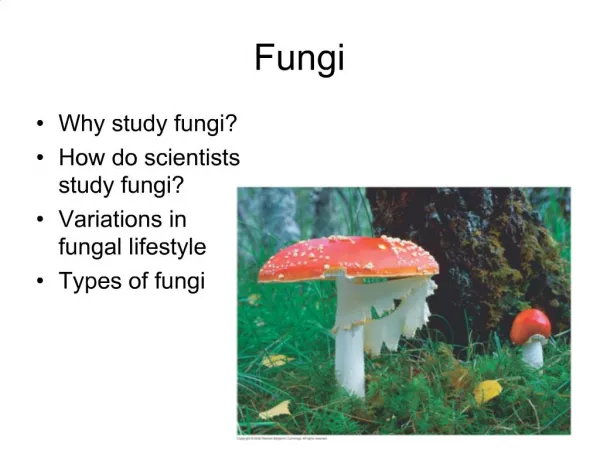
Fungi Kingdom Characteristics • Eukaryotes. • Heterotrophs • Cell walls made of chitin • Use spores to reproduce. • Need warm, moist places to grow. • Examples: yeast, molds and mushrooms.
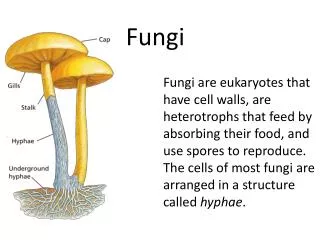
Obtaining Food • Digest food outside of their bodies then absorb it by using hyphae • Hyphae: threadlike tubes. (Shape of fungi depends on how hyphae used) • Exception is yeast which are unicellular. AND...
How Hyphae Work! • Fungus grows hyphae into food • Hyphae secrete digestive chemicals into food • Hyphae absorb decayed food
Reproduction in Fungi • Produce thousands of spores with a protective covering (carried by water and air) • If spores land in a warm, moist place they grow.
When moisture is plentiful, fungi reproduce asexually by releasing the spores or hyphae break off and grow on their own. • Reproduce sexually by fusing of hyphae, making new spores that are different from both parents.
Since yeast is unicellular, they reproduce by budding. A well fed cell grows from the body of the mother cell and breaks off from the mother.
Four Classifications of Fungi • Threadlike - produce spores in their threadlike hyphae (ex. Bread mold) • Sac - produce spores in structures that look like sacs (ex. Yeast)
Club - produce spores in structures that look like clubs (ex. Mushrooms) • Imperfect- those that cannot reproduce sexually (ex. Penicillin)
Phylum ZygomycotaBread Mold • Hyphae include: Rhizoids (root like) and stolons (stem like) • Sexual reproduction is by conjugation (fusing) of hyphae from two different strains, followed by the production of Zygospores.
Zygomycota Sporangium: Produces the spores Sporangiophore: Holds up the sporangium
Phylum Ascomycota(Sac Fungi) Cup Fungi, Yeast, Mildews • Named for the reproductive sacs or Asci that form near the tips of the hyphae. • Ascospores formed here and released into air when the ascus ruptures. • These spores germinate to form new hyphae.
Phylum: Basidiomycota(Club Fungi) • Mushrooms, Puffballs, Shelf (Bracket) Fungi • Underground hyphae intertwine and grow upward to produce a reproductive structure called a basidiocarp = a mushroom • Basidiospores are produced on the basidia, found on the edges of the gills.
Boletes: tubes instead of gills Tubes (not gills) produce spores
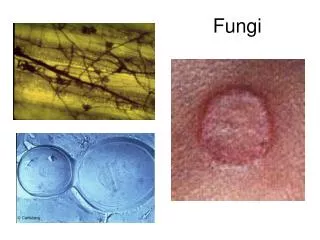
Phylum Deuteromycota (Imperfect Fungi) • Athlete’s Foot, Ringworm, Penicillium • Called “imperfect” because a sexual reproductive stage has not been observed.
Lichens • Mutualistic relationship between fungi and algae • Alga provides food, fungus provides water and a physical environment/home • Can be used as an air pollution detector
The Lichens life cycle has 3 stages 1. Crustose (appears grainy)
Many Fungi are involved in Mycorhizzae (symbiotic mutualism) relationships…Over 90% of plants have fungi associated with their roots. The fungus absorbs and concentrates phosphates for delivery to the plant roots. In return, the fungus receive sugars synthesized by the plant.