Developing Tri-Athlete Leadership in Internal Audit: A Journey Toward Mastery
160 likes | 288 Vues
Join us on a journey to develop the Chief Audit Executive (CAE) leadership skills necessary for today's dynamic environment. Our program, offered in April 2010 in Winnipeg and Vancouver, explores the key findings, learning frameworks, and essential competencies of a successful CAE. We will address challenges like relationship-building with stakeholders, providing strategic advice, and executing a robust audit plan. Through self-awareness, openness to learning, and regular practice, we aim to build leaders who excel in multiple disciplines, meeting business objectives while fostering strong interpersonal relationships.


Developing Tri-Athlete Leadership in Internal Audit: A Journey Toward Mastery
E N D
Presentation Transcript
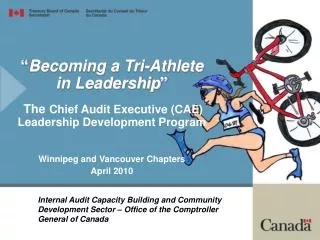
“Becoming a Tri-Athlete in Leadership”The Chief Audit Executive (CAE)Leadership Development ProgramWinnipeg and Vancouver Chapters April 2010 Internal Audit Capacity Building and Community Development Sector – Office of the Comptroller General of Canada
Why we are here today… To share with you what we have done so far to develop our CAE’s To provide you with an opportunity to reflect on your own leadership style in a particular area
What we will cover… • Background • Our Key findings • The Learning Framework • Why we are successful • A Leadership Practice
Stars align… • Implementation of IA Policy in 2006 • Federal Accountability Act in 2006 • IA Policy revised in 2009
New role emerges… • Learning needs analysis with cross-section of CAE’s to identify challenges facing the community in effectively fulfilling the new role
What we discovered… Three key challenges facing the community • The development and nurturing of relationships with multiple stakeholders (DM, SM and DAAC members) • The need to provide a broad oversight role and strategic advice • The ability to deliver a robust audit plan and quality assurance program with resources in short supply
The Tri-Athlete is born CAEs need to become warriors in the following disciplines: • Keep your friends close and your enemy closer • Tools of the Trade • The lay of the Land
Becoming a Master in all Three Disciplines Building the muscles to succeed… • Self-awareness of strengths and areas of growth • Openness to learn, to set clear and focused objectives • Regular practice and integration of feedback • Individual and collective performance
What Others will Assess… • Meet business objectives • Maintain strong interpersonal relationships that can sustain storms • Build fellowship • Meet the challenges of a changing environment • Train and further your level of mastery
Assessing my leadership competencies…. To identify which ones will require : • The MOST amount of attention and development and, • The LEAST amount of attention and development
A LEADERSHIP PRACTICE:CONNECTING 1. Individually, think of a person that you like – someone close or somewhat close to you. Write down in what ways you are just like that person? • Then, think of a person that is quite different from you – someone in your environment, someone you could actually interact with – could be a colleague, your boss, the beggar at the street corner. Write down in what ways you are just like that person? 3. In groups of two, discuss what: You are you learning from this exercise? You are learning about yourself and, How you will use this learning in the workplace?
Sharing our learning… • What insights did you get from the exercises? • What did you learn about yourself? Are you sure? • How will you apply it to the workplace?
For more information… Monique Clairoux Senior Director, IA Capacity Building and Community Development 613- 952-6255, monique.clairoux@tbs-sct.gc.ca Monique Patry Senior Advisor to Executives, IA Capacity Building & Community Development 613- 941-7166, monique.patry@tbs-sct.gc.ca