Understanding Sedimentary Rocks: Clastic, Chemical, and Organic Resources
This resource provides a comprehensive overview of sedimentary rocks, focusing on clastic, chemical, and organic types. Clastic rocks, formed from fragments of other rocks, include shale, sandstone, and conglomerate. Chemical rocks, such as limestone and halite, result from the evaporation of solutions, while organic rocks, primarily coal and oil, originate from decomposed organic matter. This guide also explains the geological processes involved in rock formation, highlighting the importance of sedimentary rocks as natural resources and their role in energy production.

Understanding Sedimentary Rocks: Clastic, Chemical, and Organic Resources
E N D
Presentation Transcript
Sedimentary Rocks 2 Clastic, Chemical, and Organic Natural Resources (coal and oil)
Vocabulary • Topography: The landscape of a place • Precipitation: The process of forming rock from a solution through evaporation
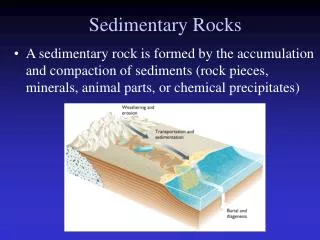
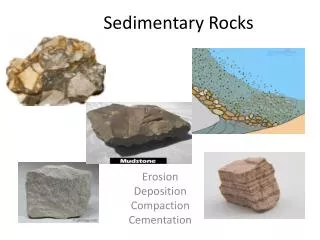
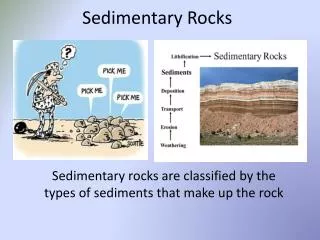
Clastic Sedimentary Rock • Clastic rock is formed through when fragments of other rocks are deposited, compacted and cemented together. • Clastic rock can take many different forms depending on the size of the fragments (clasts) • Examples of clastic rocks include: • Shale, Sandstone, Mudstone, Conglomerate, and Coal
The fragments (clasts) can be very small or quite big Sandstone Conglomerate
Let’s see this in action… http://www.classzone.com/books/earth_science/terc/content/visualizations/es0605/es0605page01.cfm?chapter_no=visualization
Chemical Sedimentary Rock • Chemical sedimentary rock forms through the process of PRECIPITATION. A solution such as sea water evaporates and leaves behind the minerals to create a new rock. • Limestone is made from a solution of Calcite that comes from sea shells • Halite (rock salt) is made when highly concentrated salt water • Often, these types of rocks are formed in arid climates where evaporation is most intense
Some examples… Halite Limestone
Organic Sedimentary Rock • Organic sedimentary rock is made from organic matter • Because organic matter can burn, this kind of rock is often used for energy. • Coal is made from dead vegetation in swamps that is compacted over time • Oil is made from dead microorganisms (like algae) that fall to the bottom of the ocean and are compacted over millions of years. • That is why they are called FOSSIL FUELS!!
Let’s see how coal is made… http://www.sceyencestudios.com/movies/coalformation.swf
Where is oil found • Oil is found in sedimentary rocks that are POROUS and can soak up the oil. • When geologists are looking for oil, they look for sedimentary rocks like shale that can hold oil.