Understanding Bayesian Networks: Syntax, Semantics, and Structure
160 likes | 286 Vues
This overview delves into the essentials of Bayesian networks, a graphical representation that succinctly encodes conditional independence assertions and joint distributions. We explore the syntax, which comprises nodes representing variables and directed acyclic graphs that depict causal relationships. Each node's distribution is conditioned on its parents, encapsulated in a Conditional Probability Table (CPT). We discuss the network's topology reflecting causal knowledge and provide examples illustrating independence assumptions. Additionally, we outline the process of constructing Bayesian networks to model complex dependencies efficiently.


Understanding Bayesian Networks: Syntax, Semantics, and Structure
E N D
Presentation Transcript
Outline • Syntax • Semantics
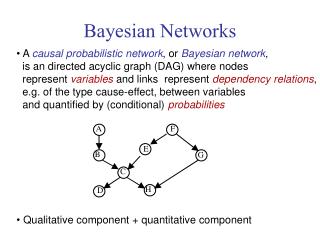
Bayesian networks • A simple, graphical notation for conditional independence assertions and hence for compact specification of full joint distributions • Syntax: • a set of nodes, one per variable • a directed, acyclic graph (link ≈ "directly influences") • a conditional distribution for each node given its parents: • P (Xi | Parents (Xi)) • In the simplest case, conditional distribution represented as a conditional probability table (CPT) giving the distribution over Xi for each combination of parent values
Example • Topology of network encodes conditional independence assertions: • Weather is independent of the other variables • Toothache and Catch are conditionally independent given Cavity
Example • I'm at work, neighbor John calls to say my alarm is ringing, but neighbor Mary doesn't call. Sometimes it's set off by minor earthquakes. Is there a burglar? • Variables: Burglary, Earthquake, Alarm, JohnCalls, MaryCalls • Network topology reflects "causal" knowledge: • A burglar can set the alarm off • An earthquake can set the alarm off • The alarm can cause Mary to call • The alarm can cause John to call
Example contd. P(A) P(J) P(M)
Compactness • A Conditional Probability Table CPT for Boolean Xi with k Boolean parents has 2k rows for the combinations of parent values • Each row requires one number p for Xi = true(the number for all Xi = false is just 1-p) • If each variable has no more than k parents, the complete network requires O(n · 2k) numbers • I.e., grows linearly with n, vs. O(2n)for the full joint distribution • For burglary net, 1 + 1 + 4 + 2 + 2 = 10 numbers (vs. 25-1 = 31)
Semantics The full joint distribution is defined as the product of the local conditional distributions: P (X1, … ,Xn) = πi = 1P (Xi | Parents(Xi)) e.g., P(j m a b e) = P (j | a) P (m | a) P (a | b, e) P (b) P (e) n
Constructing Bayesian networks • Choose an ordering of variables X1, … ,Xn • For i = 1 to n • add Xi to the network • select parents from X1, … ,Xi-1 such that P (Xi | Parents(Xi)) = P (Xi | X1, ... Xi-1) This choice of parents guarantees: P (X1, … ,Xn) = πi =1P (Xi | X1, … , Xi-1)(chain rule) = πi =1P (Xi | Parents(Xi))(by construction) n n
Example • Suppose we choose the ordering M, J, A, B, E P(J | M) = P(J)?
Example • Suppose we choose the ordering M, J, A, B, E P(J | M) = P(J)? No P(A | J, M) = P(A | J)P(A | J, M) = P(A)?
Example • Suppose we choose the ordering M, J, A, B, E P(J | M) = P(J)? No P(A | J, M) = P(A | J)?P(A | J, M) = P(A)? No P(B | A, J, M) = P(B | A)? P(B | A, J, M) = P(B)?
Example • Suppose we choose the ordering M, J, A, B, E P(J | M) = P(J)? No P(A | J, M) = P(A | J)?P(A | J, M) = P(A)? No P(B | A, J, M) = P(B | A)? Yes P(B | A, J, M) = P(B)? No P(E | B, A ,J, M) = P(E | A)? P(E | B, A, J, M) = P(E | A, B)?
Example • Suppose we choose the ordering M, J, A, B, E P(J | M) = P(J)? No P(A | J, M) = P(A | J)?P(A | J, M) = P(A)? No P(B | A, J, M) = P(B | A)? Yes P(B | A, J, M) = P(B)? No P(E | B, A ,J, M) = P(E | A)? No P(E | B, A, J, M) = P(E | A, B)? Yes
Example contd. • Deciding conditional independence is hard in noncausal directions • (Causal models and conditional independence seem hardwired for humans!) • Network is less compact: 1 + 2 + 4 + 2 + 4 = 13 numbers needed
Summary • Bayesian networks provide a natural representation for (causally induced) conditional independence • Topology + CPTs = compact representation of joint distribution • Generally easy for domain experts to construct