SlideServe
Menu
Préférences
© SlideServe · v2026

Controlling Methane Hydrate Formation at the Molecular Level: Insights from Stony Brook University

zahir-davenport avatar
1 diapositives · 170 Views · Nov 19, 2014

This study investigates the molecular-level control of methane hydrate formation, crucial for enhancing natural gas applications. By forming polyhedral cavities through water’s hydrogen bonding, methane can be trapped, offering potential for alternative desalination techniques and more efficient gas transport than liquefied natural gas. Our unique cell design allowed us to explore interfacial phenomena using neutron and laser reflectivity, revealing that microscopic hydrate formation begins rapidly within a minute under stable conditions, with significant growth occurring shortly after the induction period.
Controlling Methane Hydrate Formation at the Molecular Level: Insights from Stony Brook University - slide 1
01 / 1Controlling Methane Hydrate Formation at the Molecular Level: Insights from Stony Brook University
1 / 17

Télécharger la présentation

Controlling Methane Hydrate Formation at the Molecular Level: Insights from Stony Brook University
Une image / un lien ci-dessous est fourni (tel quel) pour télécharger la présentation

Politique de téléchargement : le contenu du site vous est fourni TEL QUEL pour votre information et votre usage personnel ; il ne peut être vendu, concédé sous licence ni partagé sur d’autres sites sans l’accord de son auteur.Le contenu vous est fourni TEL QUEL, pour votre information et votre usage personnel uniquement. Téléchargez la présentation en cliquant sur ce lien. Lors du téléchargement, si vous ne parvenez pas à télécharger une présentation, l’éditeur a peut-être supprimé le fichier de son serveur.Pendant le téléchargement, si vous ne parvenez pas à obtenir une présentation, le fichier a peut-être été supprimé par l’éditeur.

F I N

Plus de contenu associé

Transcription de la présentation
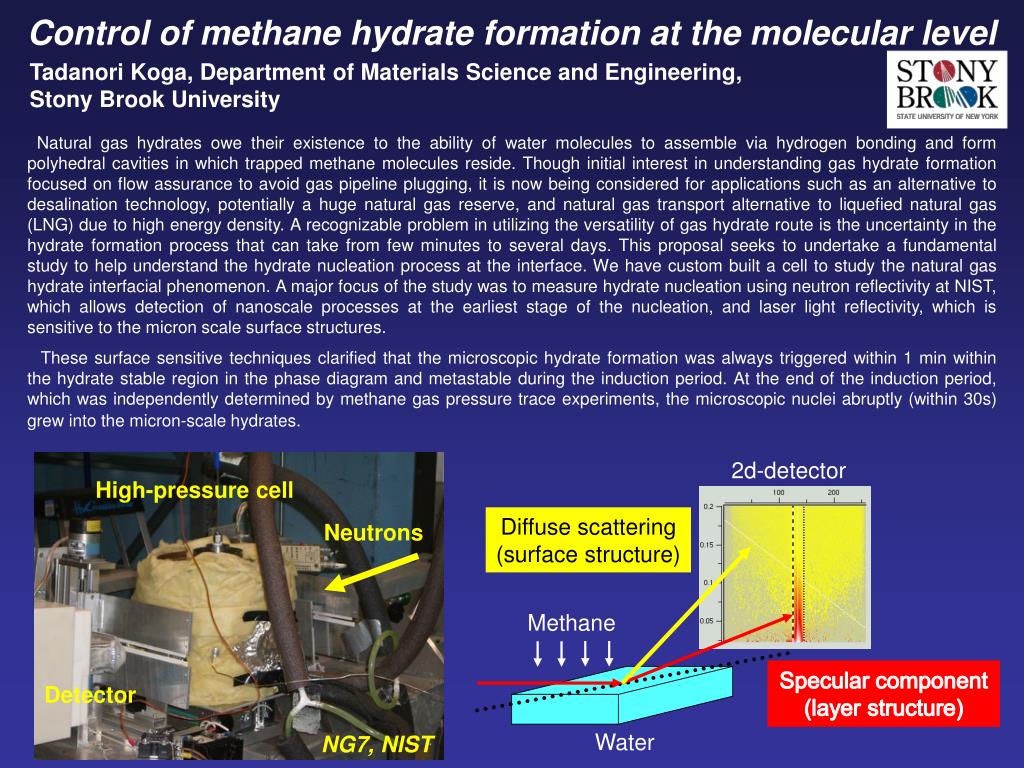
  1. Control of methane hydrate formation at the molecular level Tadanori Koga, Department of Materials Science and Engineering, Stony Brook University Natural gas hydrates owe their existence to the ability of water molecules to assemble via hydrogen bonding and form polyhedral cavities in which trapped methane molecules reside. Though initial interest in understanding gas hydrate formation focused on flow assurance to avoid gas pipeline plugging, it is now being considered for applications such as an alternative to desalination technology, potentially a huge natural gas reserve, and natural gas transport alternative to liquefied natural gas (LNG) due to high energy density. A recognizable problem in utilizing the versatility of gas hydrate route is the uncertainty in the hydrate formation process that can take from few minutes to several days. This proposal seeks to undertake a fundamental study to help understand the hydrate nucleation process at the interface. We have custom built a cell to study the natural gas hydrate interfacial phenomenon. A major focus of the study was to measure hydrate nucleation using neutron reflectivity at NIST, which allows detection of nanoscale processes at the earliest stage of the nucleation, and laser light reflectivity, which is sensitive to the micron scale surface structures. These surface sensitive techniques clarified that the microscopic hydrate formation was always triggered within 1 min within the hydrate stable region in the phase diagram and metastable during the induction period. At the end of the induction period, which was independently determined by methane gas pressure trace experiments, the microscopic nuclei abruptly (within 30s) grew into the micron-scale hydrates. 2d-detector High-pressure cell Diffuse scattering (surface structure) Neutrons Methane Specular component (layer structure) Detector Water NG7, NIST