Exploring the Central Limit Theorem through Die Rolls and Sample Means
190 likes | 332 Vues
This presentation guides you through an engaging experiment using dice to illustrate the Central Limit Theorem (CLT). You will roll a die multiple times (5, 10, and 20 times), record the results, and calculate sample means over 250 trials. The mean and standard deviations of these sample means will be compared to the population mean. Additionally, real-world applications such as estimating costs and salaries using normal distributions are explored, providing insights into how sample sizes affect statistical outcomes. Discover the significance of the CLT in statistics!


Exploring the Central Limit Theorem through Die Rolls and Sample Means
E N D
Presentation Transcript
Roll a die 5 times and record the value of each roll. • Find the mean of the values of the 5 rolls. • Repeat this 250 times.
Don’t forget: You can copy-paste this slide into other presentations, and move or resize the poll.
x=3.504 s=.7826 n=5
Roll a die 10 times and record the value of each roll. • Find the mean of the values of the 10 rolls • Repeat this 250 times.
Poll: Toss a die 10 times and record your resu... Don’t forget: You can copy-paste this slide into other presentations, and move or resize the poll.
x=3.48 s=.5321 n=10
Roll a die 20 times. • Find the mean of the values of the 20 rolls. • Repeat this 250 times.
Don’t forget: You can copy-paste this slide into other presentations, and move or resize the poll.
x=3.487 s=.4155 n=20
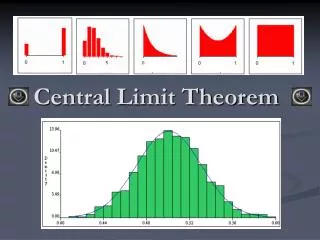
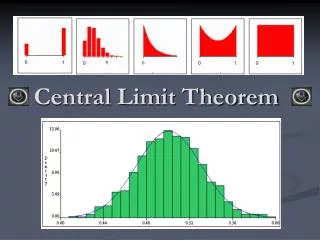
What do you notice about the shape of the distribution of sample means?
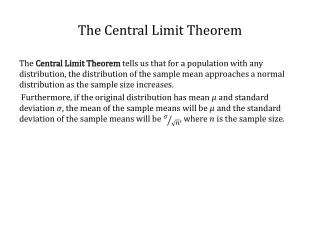
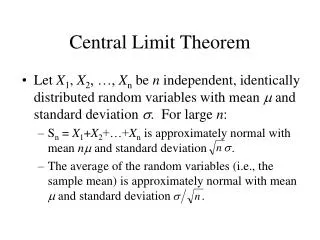
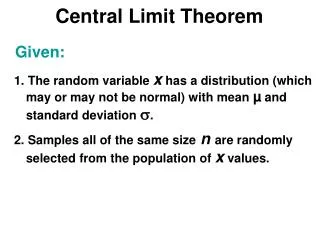
Central Limit Theorem • Suppose we take many random samples of size n for a variable with any distribution--- For large sample sizes: • The distribution of means will be approximately a normal distribution.
1, 2, 3, 4, 5, 6 • Mean: =3.5 • Standard Deviation: =1.7078 • How does the mean of the sample means compare to the mean of the population? • Remember for 250 trials: • When n=5, x=3.504 • When n=10, x=3.48 • When n=20, x=3.487 • How does the mean of the sample means compare to the mean of the population?
Central Limit Theorem • Suppose we take many random samples of size n for a variable with any distribution--- For large sample sizes: • The distribution of means will be approximately a normal distribution. • The mean of the distribution of means approaches the population mean, .
1, 2, 3, 4, 5, 6 • Mean: =3.5 • Standard Deviation: =1.7078 • How does the standard deviation of the sample means compare to the standard deviation of the population? • Remember for 250 trials: • When n=5, s=.7826 • When n=10, s=.5321 • When n=20, s=.4155 • How does the standard deviation of the sample means compare to the standard deviation of the population?
Central Limit Theorem • Suppose we take many random samples of size n for a variable with any distribution--- For large sample sizes: • The distribution of means will be approximately a normal distribution. • The mean of the distribution of means approaches the population mean, . • The standard deviation of the distribution of means approaches .
Cost of owning a dog • Suppose that the average yearly cost per household of owning dog is $186.80 with a standard deviation of $32. Assume many samples of size n are taken from a large population of dog owners and the mean cost is computed for each sample. • If the sample size is n=25, find the mean and standard deviation of the sample means. • If the sample size is n=100, find the mean and standard deviation of the sample means.
Teacher’s salary • The average teacher’s salary in New Jersey (ranked first among states) is $52,174. Suppose the distribution is normal with standard deviation equal to $7500. • What percentage of individual teachers make less than $45,000? • Assume a random sample of 64 teachers is selected, what percentage of the sample means is a salary less than $45,000?
Height of basketball players • Assume the heights of men are normally distributed with a mean of 70.0 inches and a standard deviation of 2.8 inches. • What percentage of individual men have a height greater than 72 inches? • The mean height of a 16 man roster on a high school team is at least 72 inches. What percentage of sample means from a sample of size 16 are greater than 72 inches? • Is this basketball team unusually tall?