The Circulatory System
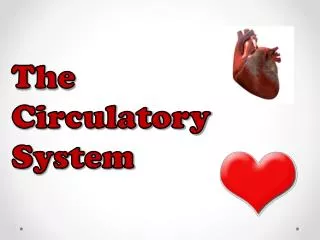
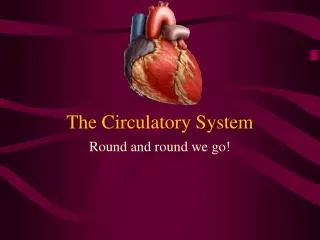
The circulatory system is crucial for transportation and homeostasis in the body. It comprises two main divisions: the cardiovascular system and the lymphatic system. The cardiovascular system includes the heart, blood, and blood vessels—arteries, veins, and capillaries. The heart, which has three layers and four chambers, pumps oxygenated blood to body tissues and deoxygenated blood to the lungs. Key functions include regulating blood pressure and ensuring proper blood flow through valves. Understanding its physiology, including the conduction system and factors affecting blood pressure, is essential for maintaining heart health.

The Circulatory System
E N D
Presentation Transcript
The Circulatory System • Major Function • TRANSPORTATION • Helps maintain homeostasis within the body • Two sub-divisions • Cardiovascular system • Lymphatic system
The Cardiovascular System • Consists of: • Blood • Transporting fluid • Heart • Pumps the blood • Carries the blood • Arteries, veins, capillaries
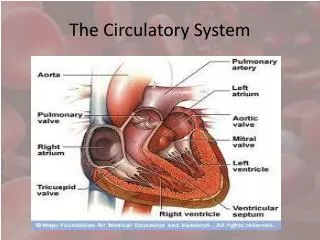
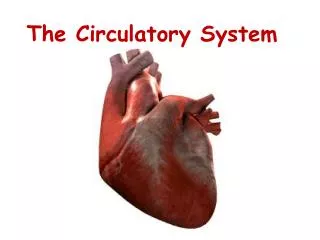
The Heart • Heart wall has 3 layers • Epicardium, myocardium, endocardium • Made of cardiac muscle • Rich in mitochondria • Four chamber • Two Atria – upper chambers • Pumps blood to the ventricles • Two Ventricles – lower chambers • Left pumps blood to the entire body • Right pumps blood to the lungs
Blood Flow in the Heart • Oxygen-poor blood enter through the superior & inferior venae cavae into the right atrium • Passes down through the tricuspid valve to the right ventricle. • Passes out the pulmonary trunk arteries to the lungs & gas exchange occurs. • Oxygen-rich blood returns via the pulmonary veins & passes into the left atrium. • Flows down through the bicuspid valve or mitral valve to the left ventricle. • Oxygen-rich blood then flows out the aorta to the body tissues.
Physiology of the Heart • Heartbeat & Heart Sounds • Two phases of the heartbeat • Diastole (relaxation) • Occurs when the ventricle walls relax & blood flows into the heart from the venae cavae & pulmonary veins • Tricuspid & mitral valves open; pulmonary & aortic valves close • Systole (contraction) • Walls of right & left ventricles contract; pumping blood into the pulmonary artery & aorta • Tricuspid & mitral valves are closed, preventing backflow
Physiology of the Heart • Closure of the valves is associated with audible sounds • “lubb-dubb” • “Lubb” associated with closure of the tricuspid & mitral valves at the beginning of systole • “Dubb” closure of the aortic & pulmonary valves at the end of systole • Murmur • Abnormal swishing sound • http://www.dundee.ac.uk/medther/Cardiology/audio/normal.wav • http://www.dundee.ac.uk/medther/Cardiology/audio/ms.wav
Physiology of the Heart • Conduction System • Sinoatrial Node (SA Node) • (pacemaker) • Specialized muscle tissue that initiates the heartbeat • Wave of electricity passes to another region of the myocardium (within the interatrial septum) to the Atrioventricular node (AV node) • AV node sends excitation wave to atrioventricular bundle (bundle of His) • Bundle divides into the left bundle branch & right bundle branch
Physiology of the Heart • Electrocardiogram (ECG or EKG) • Record used to detect the electrical changes in the heart muscle
Blood Vessels • Arteries • Large blood vessels that carry blood away from the heart • Lined with connective tissue, muscle, tissue, elastic layer, & endothelium (innermost layer) • Strong to withstand high pressure pumping from the heart • Arterioles • Smaller branches of arteries • Thinner & carry blood to capillaries
Blood Vessels • Capillaries • One endothelial cell thick • Carry nutrient-rich, oxygenated blood from the arteries & arterioles to the body cells • Pick up waste products (i.e. CO2) & flow back to the small venules, which combine to form larger vessels called the veins.
Blood Vessels • Veins • Thinner walls compared with arteries • Take blood toward the heart • Have valves to prevent the backflow of blood
Blood Pressure • Blood moves through our Circulation System because it is under Pressure. • caused by the Contraction of the Heart and by Muscles that surround Blood Vessels. • Blood Pressure is Always highest in the Two Main Arteries that leave the Heart. • Maintained by TWO WAYS: • (1) The Nervous System, which can speed up or slow down the Heart Rate; • (2) The KIDNEYS, which regulate blood pressure by the amount of fluid in our Blood. • When pressure is too high, kidneys remove water from blood, lowering the total amount of fluid in the Circulatory System. • Both High and LOW Blood Pressure can cause our bodies problems.
Blood Pressure • Usually Measured in the Artery Supplying the upper Arm. • Measured by a sphygmomanometer • Systolic Blood Pressure • force of blood recorded during ventricular contraction • Diastolic Blood Pressure • force of blood reordered during ventricular relaxation • Average blood pressure = 120/80 mm Hg
Factors Affecting Blood Pressure • Neural Factors • Renal Factors – Kidneys • Temperature • Chemicals • Diet • Age & Weight • Exercise • Emotional State
Cardiac Disorders • Risk factors of heart disease • High blood pressure, high blood cholesterol, cigarette smoking, obesity, lack of exercise, diabetes mellitus, and genetics. • Immediate Causes of Heart Disease • Inadequate blood supply, anatomical disorders, arrhythmias • CHF – Congestive Heart Failure • Heart cannot meet the body’s oxygen demands
The Lymphatic System • Consists of lymphatic vessels, lymph nodes, & lymph organs. • Supports both Cardiovascular System & the Immune System. • Functions: • Picks up fluid leaked from the blood vessels & returns it to the blood. • Disposes of debris in the lymphatic stream • Houses WBCs involved in immunity
Lymphatic Vessels • Picks up excess tissue fluid called lymph, & returns it to the bloodstream. • Fluid accumulation in tissues can cause edema, which impairs blood-to-tissue exchange • One-way system towards the heart • Lymph capillaries absorb fluid in tissues • Enters the venous system through two large ducts • Right lymphatic duct • Thoracic duct
Lymph Nodes • Removes foreign material from the lymphatic stream by producing lymphocytes (WBCs) that function in immune response. • Act as tiny filters • Contain macrophages that engulf & destroy bacteria • Swollen glands are a result of trapping substances in the nodes.
Other Lymphoid Organs • Spleen • Filters blood & destroys worn-out RBCs & returns the breakdown products to the liver • Thymus • Produces hormones that program lymphocytes (immune system cells) • Tonsils • Masses of lymphoid tissue embedded in mucus • Trap any foreign material entering the throat.