Download
1 / 1
10 likes | 112 Vues
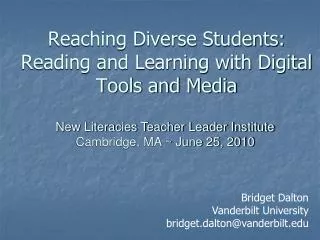
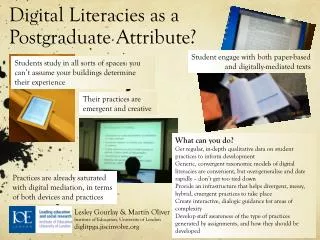
This guide explores the dynamic relationship between students and their engagement with both paper-based and digital texts in various learning spaces. It emphasizes the importance of understanding student practices, which are often emergent and creative, rather than assuming fixed environments dictate their experiences. To develop effective digital literacy frameworks, educators should gather qualitative data on student interactions, provide infrastructure for diverse practices, and create supportive, dialogic guidance. Staff should be aware of practices influenced by assignments and adapt to the evolving digital landscape.

E N D
Student engage with both paper-based and digitally-mediated texts Students study in all sorts of spaces: you can’t assume your buildings determine their experience Their practices are emergent and creative Digital Literacies as a Postgraduate Attribute? What can you do? Get regular, in-depth qualitative data on student practices to inform development Generic, convergent taxonomic models of digital literacies are convenient, but over-generalise and date rapidly – don’t get too tied down Provide an infrastructure that helps divergent, messy, hybrid, emergent practices to take place Create interactive, dialogic guidance for areas of complexity Develop staff awareness of the type of practices generated by assignments, and how they should be developed Practices are already saturated with digital mediation, in terms of both devices and practices Lesley Gourlay & Martin Oliver Institute of Education, University of London diglitpga.jiscinvolve.org