Understanding Global Circulation and Paleoclimatology: Climate Dynamics and Feedback Loops
This article explores the intricate mechanisms of global circulation driven by pressure differences, which are influenced by factors like heating at the equator and the effects of jet streams. It delves into the significance of semi-permanent high and low-pressure cells, as well as their role in ocean circulation and climate variability. The importance of feedback loops in weather events and climate change is highlighted, including examples of "vicious cycles." Additionally, methods of studying paleoclimate through ice cores, marine sediments, and dendroclimatology are discussed to comprehend past climate controls and future predictions.

Understanding Global Circulation and Paleoclimatology: Climate Dynamics and Feedback Loops
E N D
Presentation Transcript
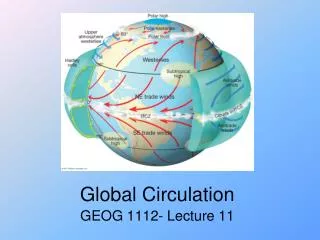
GLOBAL CIRCULATION • most winds are driven by pressure differences • in the atmosphere • pressure differences can be created by:
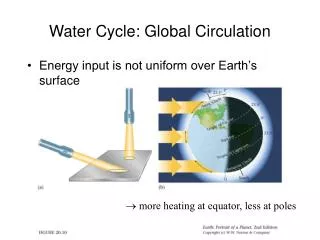
More heating occurs at the equator due to higher sun angles
Jet stream • an upper level • wind belt located • at the
(red arrows) and semi- • permanent high and low pressure cells
(red arrows) and semi- • permanent high and low pressure cells
cause the oceans to circulate in a • series of
a temporary shift in the climate of the planet • results due to the
Feedback--: Feedback “loops” are important in short term weather events and for long-term climate change ---the response of a system to a stimulus moderates or decreases the initial change e.g. the atmosphere warms evaporation increases more clouds form more reflection of solar radiation occurs the atmosphere cools
---response of a system to a stimulus amplifies the initial change (“vicious cycle” or “snowball effect”) e.g.: the atmosphere warms the oceans warm warm water absorbs less CO2 CO2 increases in the atmospherethe atmosphere warms more
Why paleoclimatology? • to understand the controls that shape • our present climate • to explain many present day geologic and • biologic patterns on the Earth • to (hopefully) predict future climate change