Download

1 / 10
100 likes | 209 Vues
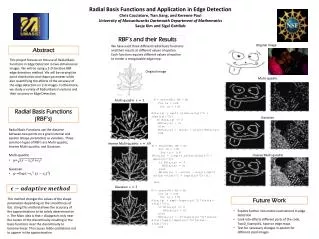
This project explores the application of Radial Basis Functions (RBFs) for edge detection in one-dimensional and two-dimensional images. Utilizing a 2-D iterative method, we examine the impact of point distribution and the shape parameter on detection accuracy. A variety of RBFs—including Multi-Quadric, Inverse Multi-Quadric, and Gaussian—are analyzed to determine their effectiveness in edge detection. The study employs MATLAB for code analysis and aims to enhance image processing techniques by assessing the influence of parameters like epsilon on edge detection outcomes.

E N D
Radial Basis Functions and Application in Edge Detection Chris Cacciatore Tian Jiang Kerenne Paul
Abstract • This project focuses on the use of Radial Basis Functions in Edge Detection in both one-dimensional and two-dimensional images. • Use a 2-D iterative RBF edge detection method. • Vary the point distribution and shape parameter. • Quantify the effects of the accuracy of the edge detection on 2-D images. • Study a variety of Radial Basis Functions and their accuracy in Edge Detection.
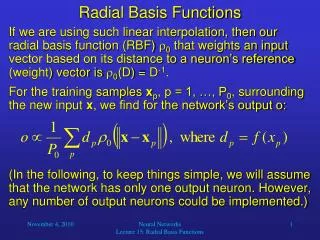
Radial Basis Functions • Multi-Quadric RBF: • Inverse Multi-Quadric RBF: • Gaussian RBF: ()
Project with Maple Leaf Initial image The most accurate image epsilon = 0.1
Epsilon Variable epsilon = 0.01 epsilon = 0.05 epsilon = 0 epsilon = 1 epsilon = 2 epsilon = 0.1
Edge Detection with another image Initial image
Epsilon Variable epsilon = 0 epsilon = 0.05 epsilon = 0.1 epsilon = 0.3 epsilon = 1 epsilon = 0.2
Epsilon Variable Epsilon=0.2 Epsilon=0.3 more accurate
What to do: • Get familiar with MATLAB and use it to help analyze the code • Find other factors in the code rather than epsilon to make the image look different • Research further into how the code used works with Radial Basis Function (Multi-Quadric RBF) • Investigate the other two RBFs and their practicality in edge detection