
SlideServe
Menu
Préférences
© SlideServe · v2026

State Changes

alamea avatar
10 diapositives · 328 Views · Jul 10, 2014

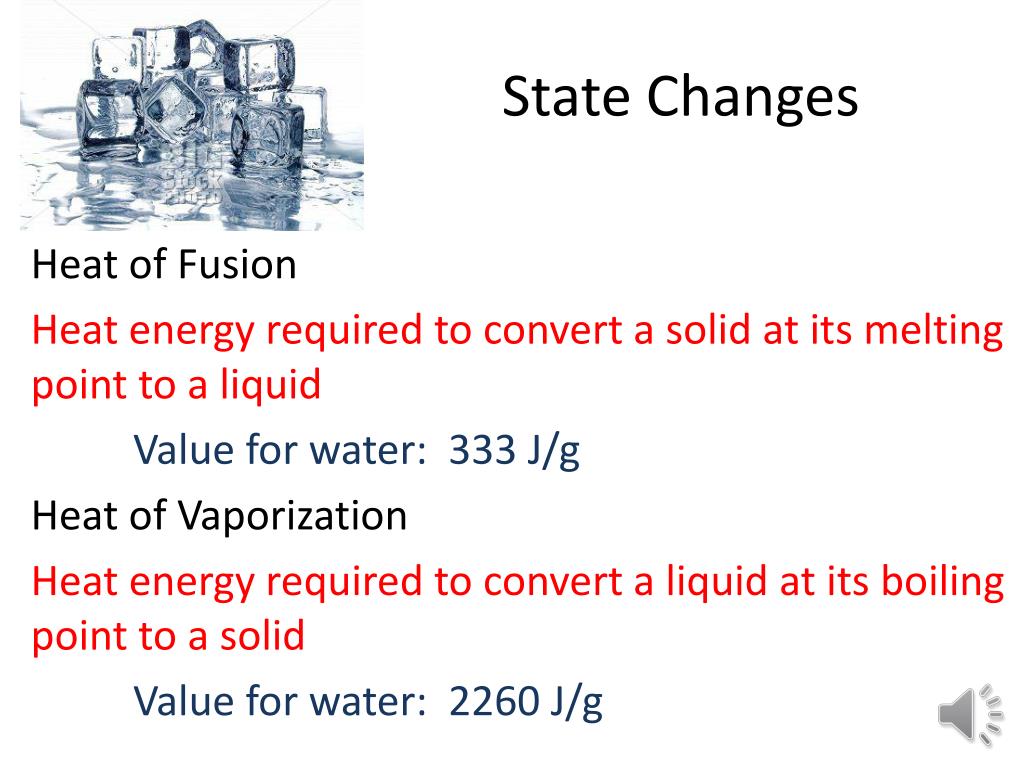
State Changes. Heat of Fusion Heat energy required to convert a solid at its melting point to a liquid Value for water: 333 J/g Heat of Vaporization Heat energy required to convert a liquid at its boiling point to a solid Value for water: 2260 J/g. Vaporization
State Changes - slide 1
01 / 10State Changes
1 / 17

Télécharger la présentation

State Changes
Une image / un lien ci-dessous est fourni (tel quel) pour télécharger la présentation

Politique de téléchargement : le contenu du site vous est fourni TEL QUEL pour votre information et votre usage personnel ; il ne peut être vendu, concédé sous licence ni partagé sur d’autres sites sans l’accord de son auteur.Le contenu vous est fourni TEL QUEL, pour votre information et votre usage personnel uniquement. Téléchargez la présentation en cliquant sur ce lien. Lors du téléchargement, si vous ne parvenez pas à télécharger une présentation, l’éditeur a peut-être supprimé le fichier de son serveur.Pendant le téléchargement, si vous ne parvenez pas à obtenir une présentation, le fichier a peut-être été supprimé par l’éditeur.

F I N

Plus de contenu associé

Transcription de la présentation
  1. State Changes Heat of Fusion Heat energy required to convert a solid at its melting point to a liquid Value for water: 333 J/g Heat of Vaporization Heat energy required to convert a liquid at its boiling point to a solid Value for water: 2260 J/g

  2. Vaporization endothermic process (H positive) Condensation exothermic process (H negative) Melting endothermic process (H positive) Freezing exothermic process (H negative)

  3. Finding the Energy to Change the State of a Given Mass of a Substance -Pause the video and solve the problems below. J = (mass)(heat of vaporization or heat of fusion) Find the heat energy needed to change 50.0 g of water from liquid to gas. How much heat energy will be released when 50.0 g of water freeze (change from liquid to solid)?

  4. Finding the Energy to Change the State of a Given Mass of a Substance -Pause the video and solve the problems below. J = (mass)(heat of vaporization or heat of fusion) Find the heat energy needed to change 50.0 g of water from liquid to gas. (2260J/g)(50.0g) = 1.13 x 10⁶ J How much heat energy will be released when 50.0 g of water freeze (change from liquid to solid)? (-333J/g)(50.0g) = -1.67 x 10⁵ J

  5. Graphing Temperature v. Time During a State Change 120 Temperature (C) -10 Time (min)

  6. Why do the plateaus occur in this graph even though heat was steadily added over time?

  7. Cpgas = 1.86 J/gK Heat of vaporization = 2260J/g Specific heat of water = 4.184J/gK heat of fusion = 333 J/g Specific heat of ice = 2.06 J/gK

  8. Find the energy needed to convert 500.g of ice at -50.0 C to steam at 200. C. Pause the video while you solve the problem. • Solve this in 5 steps by finding energy needed to: • Heat ice from -50.0 to 0 using specific heat of ice • Melt ice using heat of fusion of ice • Heat water from 0 to 100 using specific heat of water • Boil water using heat of vaporization of water • Heat steam from 100 to 200. using specific heat of steam • Then add all of these q values together to find the total amount of energy needed.

  9. Find the energy needed to convert 500.g of ice at -50.0C to steam at 200. C. Pause the video while you solve the problem. • Solve this in 5 steps by finding energy needed to: • Heat ice from -50.0 to 0 using specific heat of ice • q = (2.06J/gK)(50.0g)(0 C - -50.0C) = 5.15 x 10⁴J • Melt ice using heat of fusion of ice • q = (333J/g)(50.0g) = 1.67 x 10⁵J • Heat water from 0 to 100 using specific heat of water • q = (4.184J/gK)(50.0g)(100 C - 0C) = 2.09 x 10⁵J • Boil water using heat of vaporization of water • q = (2260J/g)(50.0g)= 1.13 x 10⁶J • Heat steam from 100 to 200. using specific heat of steam • q = (1.86J/gK)(50.0g)(200. C – 100.0C) = 9.30 x 10⁴J • Then add all of these q values together to find the total amount of energy needed. 1650kJ

  10. Let’s try something harder!!! Pause the video while you solve the problem. Suppose you pour 250. mL of tea (density 1g/mL) at 18.2C into a glass with 5 ice cubes (each weighing 15g). What quantity of ice will melt and what mass will remain? (Hint: the tea will cool until it is at thermal equilibrium with the ice at 0 C.) Assume the specific heat of tea is 4.2J/gK.