Calculating Actual Yield of Potassium Sulfate with Silver(II) Sulfate and Potassium Phosphate
This exercise involves calculating the actual yield of Potassium Sulfate from a reaction starting with 15 g of Silver(II) Sulfate and excess Potassium Phosphate, achieving a 75% yield. The relevant chemical reaction can be represented as: AgSO4 + K3PO4 → Ag3(PO4)2 + K2SO4. Additionally, explore concepts like density, chemical and physical properties, and laws of conservation of mass, definite proportions, and multiple proportions. Answer questions on key scientific topics such as isotopes, formulas for various compounds, and the distinctions between strong and weak electrolytes.


Calculating Actual Yield of Potassium Sulfate with Silver(II) Sulfate and Potassium Phosphate
E N D
Presentation Transcript
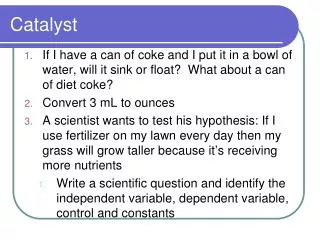
Catalyst • Pick up Papers from the front • Calculate the actual yieldof Potassium Sulfate if you started with 15 g of Silver (II) Sulfate and excess Potassium Phosphate, which produced Potassium Sulfate at a 75% yield. • Use the following equation: • AgSO4 + K3PO4 Ag3(PO4)2 + K2SO4
Catalyst • Pick up Papers from the front • Calculate the actual yieldof Potassium Sulfate if you started with 15 g of Silver (II) Sulfate and excess Potassium Phosphate, which produced Potassium Sulfate at a 75% yield. • Use the following equation: • AgSO4 + K3PO4 Ag3(PO4)2 + K2SO4
Explosion! (3 MINUTES) ? ? ? ? ? ? ? ? ? ? ?
Explosion Questions • What is the formula for density? • Give an example of a chemical property. • Give an example of a physical property. • What is the law of conservation of mass? • What is the law of definite proportions? • What is the law of multiple proportions? • Who discovered the electron? • What are the three types of radiation? • Which particle is the biggest? • Which is the smallest? • Who is Ernest Rutherford? • How do you find the number of neutrons? • What is an isotope? • What is the formula for Nitrite? • What is the formula for Perchlorate? • What is the formula for Hyposulfite? • What is the empirical formula? • What is the molecular formula? • What is the limiting reagent? • What is the excess reagent? • What is the % yield? • What is % composition? • What does it mean to be aqueous?
Electronegativity: The desire an atom has for electrons! Fluorine is the MOST electronegative element!
Chart of Electronegativities – let’s compare H and O! What does this mean?
We know that H and O SHARE their electrons, so….let’s try drawing the Lewis Dot Structure to get more information δ- O H H So Oxygen has 2 lone pairs attached in order to fill it’s octet It is also more electronegative than H…which means that O has a partial NEGATIVE charge!
We know that H and O SHARE their electrons, so….let’s try drawing the Lewis Dot Structure to get more information δ- O H H So Oxygen has 2 lone pairs attached in order to fill it’s octet It is also more electronegative than H (it pulls the shared electrons a little more…which means that O has a partial NEGATIVE charge!
We know that H and O SHARE their electrons, so….let’s try drawing the Lewis Dot Structure to get more information δ- O H H δ+ δ+ Since H is less electronegative, it pulls on the electrons LESS, so it has a partial POSITIVE charge
Because there is a difference in charge, this is called a POLAR Molecule δ- O H H δ+ δ+ It also has a BENT shape!
Positive Ions will be attracted to the O end of the water molecule δ- O H H δ+ δ+ And Negative Ions will be attracted to the H ends of the water molecule Because opposites attract!
Other polar molecules will be easily dissolved in water as well, because of the electromagnetic force involved! (opposite charges attract!) δ- O H H δ+ δ+ Therefore…
“Like dissolves like”: Polar solvents (like water) can dissolve polar and ionic solute! “Like dissolves like”: Non-Polar solvents can dissolve non polar solutes (like fats!)!
Electrolyte: A substance that when dissolved in water can produce a solution that conducts an electric current STRONG Electrolyte: produce a very STRONG current (bright light) Ex: Ionic compounds, Strong Bases (NaOH), Strong Acids (HNO3) – these fully break apart (dissociate)
Electrolyte: A substance that when dissolved in water can produce a solution that conducts an electric current WEAK Electrolyte: produce a very WEAK current (dim light) Ex. Weak Acids (Acetic Acid), Weak Bases (Ammonia) - these do NOT fully dissociate
Electrolyte: A substance that when dissolved in water can produce a solution that conducts an electric current NON Electrolytes: produce NO current (zero light) Ex. Alcohols, sugars - these do NOT dissociate at all
Need to MEMORIZE ALL STRONG ACIDS AND BASES! STRONG ACIDS: HCl, HBr, HI, HClO4, HNO3, H2SO4 STRONG BASES: Group 1 with OH ex. NaOHand KOH, etc…, Ca(OH)2, Sr(OH)2, Ba(OH)2
Let’s Come up with a way to do so! STRONG ACIDS: STRONG BASES: