Ancient Egypt
Explore the fascinating world of Ancient Egypt, highlighting its rich geography with fertile soil that supported daily life. The majority of the population consisted of farmers, laborers, and artisans. Writing systems like hieroglyphics were crucial for recording information on papyrus and tomb walls. The Egyptians worshipped a multitude of gods, each with unique specialties, and practiced elaborate burial rituals, including mummification, to prepare for the afterlife. The pharaoh held ultimate power, governing and performing rituals to uphold divine order. Delve into the key periods of Egyptian history, including the Old, Middle, and New Kingdoms.

Ancient Egypt
E N D
Presentation Transcript
Ancient Egypt NOTES 2
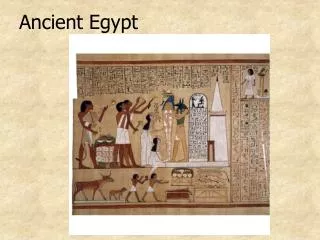
Review • Geography • ___________ – very rich soil • Daily Life • Most people were __________,___________, or ___________ • Writing system • Wrote on tomb walls and papyrus rolls using ____________ • __________ Stone was the key to _____hieroglyphics
Religion • Egyptians were ___________ • Each god or goddess were known for their own specialties • There are as many as _______gods and goddess's
Religion • Sun gods • Ra • _____ _________ • ______________ • New Kingdom • Land gods (__________) • _________ • __________ • Middle Kingdom MORE
Religion • When you died, you were ____________ • Early ancient Egyptians would bury their dead in sand pits, ____________________from the natural dehydration • Started to _____________________to protect from wild animals, but bodies would decay • Thus creating the process of mummification
Government • The _________ was the most important person in Ancient Egypt • __________ and __________leader of Egypt
Government • As 'Lord of the Two Lands‘ (______ and _______Egypt) the pharaoh owned all of the land, made laws, collected taxes, and defended Egypt against foreigners. • As ____________of Every Temple', the pharaoh represented the gods on Earth. He performed rituals and built temples to honor the gods.
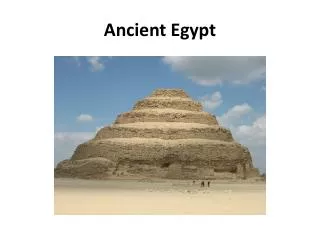
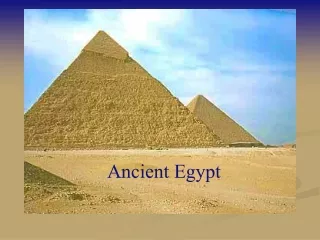
Old Kingdom • 2650-2150 BC (Collapsed due to famine and lost of government confidence) • _______________ • Preserve bodies for the afterlife • Pharaohs • Divine selection • ________ (3rd) ________, ________ & ________ (4th) • First pyramids constructed • Step pyramids of Saqqara • Great pyramid of _______
Middle Kingdom • 2040-1640 BC • 11th Dynasty- 14th Dynasty • Rule extended from ________ to __________ • Considered the “Golden Age” • ____________ II ruled from Thebes in Upper Egypt. • Hyksos move the __________ to the Nile Delta • Introduction of ____________
New Kingdom • 1540-1070 BC • __________ Leader • _________- first ______ ruler in history • Akhenaten- first _____________ • ___________- tomb discovered in 1922 • __________- the mightiest and most __________
Greco-Roman Period • Assyrian ruled from 664-653 BC • Nectanebo II- last Egyptian king • Alexander inherits the throne and founded Alexandria • General Ptolemy • Welcomed immigrants • Encouraged Greek-speaking aristocracy • Built the first lighthouse • Embraced the culture of brother-sister marriage • Opened the cities up to become more Hellenistic
Egyptian Culture Weakened • Cleopatra ruled 51-30 BC • Lived with eastern Roman ruler Mark Anthony • Overtaken by western Roman ruler, Octavian (nephew of Julius Caesar) • 27 BC- Octavian took the title of Augustus and became first Roman Emperor