CARIBIC Project: Investigating Aerosol Composition in the Upper Troposphere and Lowermost Stratosphere
90 likes | 205 Vues
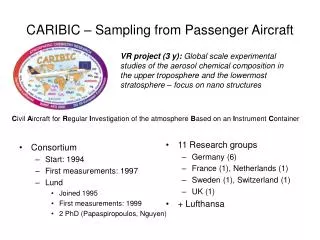
The CARIBIC initiative, launched in 1994 with first measurements in 1997, involves international collaboration focused on studying aerosol chemical composition in the upper troposphere and lowermost stratosphere. Utilizing a Lufthansa A340-600 aircraft for in situ sampling, the project analyzes trace gases, aerosol size distribution, and particulate components. Recent efforts include the classification of carbonaceous aerosols and impacts of deep convection. The research is critical for understanding atmospheric processes and climate influence on aerosol dynamics.


CARIBIC Project: Investigating Aerosol Composition in the Upper Troposphere and Lowermost Stratosphere
E N D
Presentation Transcript
Consortium Start: 1994 First measurements: 1997 Lund Joined 1995 First measurements: 1999 2 PhD (Papaspiropoulos, Nguyen) 11 Research groups Germany (6) France (1), Netherlands (1) Sweden (1), Switzerland (1) UK (1) + Lufthansa CARIBIC – Sampling from Passenger Aircraft VR project (3 y): Global scale experimental studies of the aerosol chemical composition in the upper troposphere and the lowermost stratosphere – focus on nano structures Civil Aircraft for Regular Investigation of the atmosphere Based on an Instrument Container
Aircraft LH A340-600 D-AIHE
Inlet water inlet video camera trace gas inlet aerosol inlet
O3 NOy CO Instrumentation 1.6 m 1.5 t
Trace gases In situ CO O3 NOy H2O Acetone, Methanol Air samples GHG Halogenated compounds Isotopes Special O2 DOAS (NO2, O3, BrO, HCHO) Aerosol Size distribution 3 CPC (cutoff 4, 12, 18 nm) OPC (100 nm – 5 µm) Samples (100 nm – 2µm) Quantitative analyses PIXE (S and heavier) PESA (H(?), C, N, O) Single particle analyses TEM EFTEM Meteorology (trajectories etc.) CARIBIC Measurements
Results – Single Particle Analysis TEM and EFTEM on stratospheric particle
Short term (this year) Develop H analysis Undertake large number of H, C, N, O analyses Sulfur climatology Influence of deep convection on UT/LS aerosol Longer term Methods to classify the carbonaceous component Climatology H, C, N, O Production of carbonaceous aerosol in the stratosphere Revisit single particle analysis Plans