Density in Physical Science
Learn about density as mass per unit volume, calculate densities, apply math relationships, and explore various density examples. Understand how density impacts different substances and why it varies.

Density in Physical Science
E N D
Presentation Transcript
Density Chapter 4 Physical Science
Tuesday, October 2, 2011 • Supplies: A pencil and science notebook • Standards: • 8a) Density is mass per unit volume • 8b) Calculate the density of substances from measurements of mass and volume • 9f) Apply simple mathematic relationships to determine a missing quantity
Warm-up • Given what you know about energy in solids, liquids, and gases, how and why do you think a lava lamp works.
Agenda • Pass back homework • Density Lecture • Ticket-out
What is density • Population density? • Forest density? • Density of stars? • Air quality?
Density in Physics • Density is a property of matter, like color or size. • Density is mass per unit volume. • Given a cubic centimeter of • Steel • Water • Air • Which has more mass?
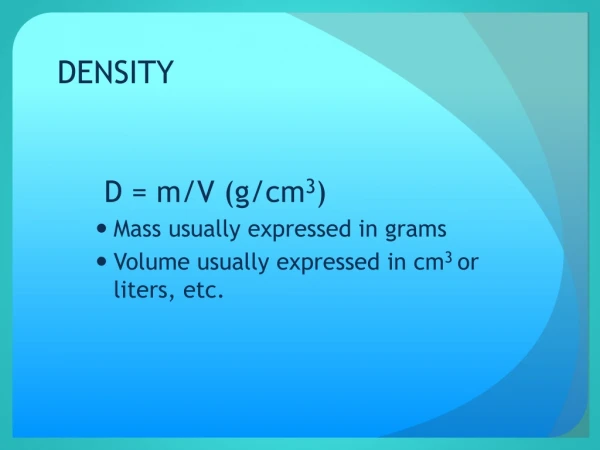
Write it • D=m/v • Solve for m • Solve for v
Solve it • A stainless steel sphere has a mass of 25 grams and a volume of 3.2 cm3. What is the density of the sphere? • A cube has a mass of 7.8 grams. The length of the sides of the cube is 1.2 cm. What is the density of the cube?
Density is a ratio • Units are g/cm3 • Ratio means • 1 g/cm3 = 1000 kg/m3 • Steel at 8.7 g/cm3 is 8,700 kg/m3 (multiply by 1000 and change units.) • Oak at 600 kg/m3 is 0.60 g/cm3 (divide by 1000 and change units.) • How does the density of oak compare to the density of water?
Solve it, them compare • Honey’s density is 1.4 g/cm3 • Write this as kg/m3 • Sandstone’s density is 20,280 kg/m3 • Write this as g/cm3 • Compare answers with with someone nearby.
Use a balance to find the mass Use a graduated cylinder to find the volume (not a beaker – why?) D = mass/volume Determining Density
Using a graduated cylinder • Read the mark at eye level • Read volume at center of meniscus (ask your teacher!) • 1 mL = 1 cm3
Volume of solids • Length X width X heights gives cubic centimeters • What is the volume of a box that is 10” long, 5” wide, and 3” high? • What is the volume of a box that is 2’ long, 1’ wide, and 9” high?
More volumes, use 3.14 for π • Sphere: V=(4/3)πr3 • What is the volume of a sphere with a radius of 2 cm? • Cylinder: V=πr3h • What is the volume of a cylinder that is 10 cm tall and has a radius of 3 cm?
Irregular shapes • Volume by displacement of fluid • Remember: 1 mL = 1 cm3 • Fill graduates cylinder with fluid to known level (50 mL) • Carefully slide object down the side of the cylinder • Compute the increase in the fluid height • 82 mL - 50 mL = 32 mL • 32 mL = 32 cm3
Compute this • I fill a graduated cylinder with 50 mL of water. • I slip a stone into the cylinder and the water raises to 62 mL. • What is the volume of the stone?
Why density varies • Mass of each atom or molecule that that makes up the substance – a calcium atom has more ‘stuff’ in it than an oxygen atom. • How tightly the atoms are packed -- the atoms are closer together in diamond that in graphite, but both are carbon. • (Except for water) solids are more dense than liquids • Liquids are more dense than gases
Ticket Out: Answer this • Which has more mass, a pound of bricks or a pound of feathers? • Which is more dense, a pound of bricks or a pound of feathers.