Understanding Modern Warfare: Characteristics, Tactics, and Historical Context
This overview explores the complex nature of warfare, defining it as an open-armed conflict between nations aimed at controlling land and people. It highlights the characteristics of conventional warfare, including the use of uniforms, known weapons, and military regulations. It discusses the evolution of U.S. military policy, the impact of guerrilla warfare, and significant conflicts like the Persian Gulf War and the War in Afghanistan. Additionally, it examines the public's changing perception of warfare and the criteria for justifying military action.

Understanding Modern Warfare: Characteristics, Tactics, and Historical Context
E N D
Presentation Transcript
War Definition • Open-armed conflict between nations • Objective: control land & people • Foreign Policy: 3-Steps • Diplomacy • Economic Sanctions • War
Characteristics of Conventional Warfare • Uniforms • Predictable • Known Weapons • Rules • No Relief Site/Red Cross • POW Treatments • Target: Miltary • Not civilians • Military sites
Characteristics Continued • Large # of troops – see movement • Expensive • Worlds Biggest Armies • China – 2 million • U.S. – 1.4 million • India – 1.3 million • Russia 1.2 million • North Korea – 1.1 million
Biggest Armies Cont. • South Korea • Pakistan • Turkey • Vietnam • Egypt
U.S. Military Policy Changes • 1970’s Vietnam Wam • Guerrilla Warfare: unconventional • Small groups • Emeshed in Civilian Society • Ambushes/Raids • War Protests – Public/People Changed Policy • The public would NOT accept large casualties of civilians and or military personnel anymore.
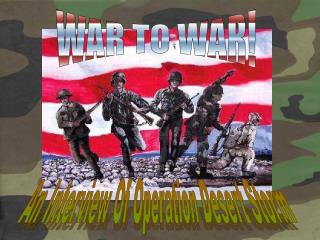
1991 Persian Gulf War • Iraq invaded Kuwait • Saddam wanted port and oil (1/4) • Whole world didn’t like it • U.S. pushed Saddam back into Iraq • Used new tactic • “Shock and Awe” – Shock enemies with new technology, they would be in awe, and they would surrender • Objective: Low Casualties
Operation Enduring Freedom • 2001: War with Afghanistan • U.N. Approved • Taliban in Afghanistan harboring Terrorist group Al Queda • Leader: Osama bin Ladin • Believed to be responsible for 9/11 • Trying to institute Democracy • Help from NATO
Operation Iraqi Freedom • 2003: War with Iraq • Not U.N. Approved • Preemptive Strike: you attack before they attack you
Reasons to Want War • Weapons of Mass Destruction • Biological, Chemical, Nuclear • Terrorism • Saddam – evil dictator • People oppressed – liberate • Democracy • Christian Just War Theory: 7 criteria must be met