Benthic Macroinvertebrate and Periphyton Monitoring in Florida's Suwannee River Basin
This report investigates spatial and temporal trends in benthic macroinvertebrates and periphyton across the Suwannee River Basin in Florida, utilizing data from 1989 to 2003. The objectives include expanding knowledge on ecological forcing factors such as eutrophication, providing essential information for Minimum Flows and Levels (MFLs) habitat control points, and defining temporal baselines. Principal Component Analysis reveals significant species associations and informs water quality monitoring and management strategies to support habitat health and ecosystem sustainability.

Benthic Macroinvertebrate and Periphyton Monitoring in Florida's Suwannee River Basin
E N D
Presentation Transcript
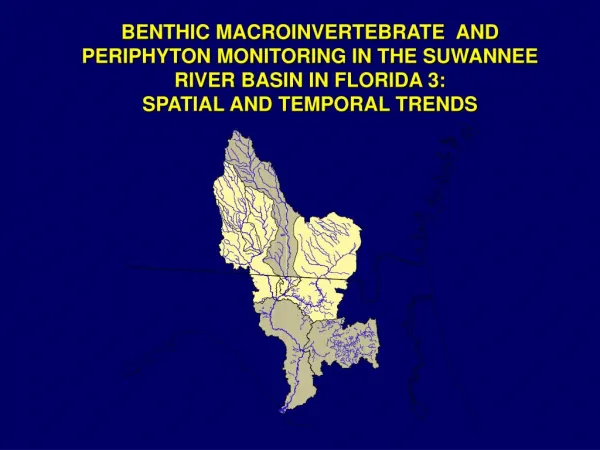
BENTHIC MACROINVERTEBRATE AND PERIPHYTON MONITORING IN THE SUWANNEE RIVER BASIN IN FLORIDA 3: SPATIAL AND TEMPORAL TRENDS
Objectives • Spatial Trends Temporal Trends Benthic Macroinvertebrates Periphyton Water Quality
Best Available Data 1989 - 2003 Hester-Dendy sampler Periphytometer
Application • Expand knowledge on ecological forcing factors (e.g., eutrophication) Provide supporting information for habitat control points for MFLs Define temporal baselines for MFLs
Spatial Trends • Principal Component Analysis to display multi-dimensional data in 2 dimensions
PCA Results • Principal Component Analysis
PCA Results Factor 1 + Ablabesmyia ramphe (.35) + Tribelos fusicorne (.31) + Slavina appendiculata (.25)Factor 2 - Stenonema exiguum (.32) + Hydropsyche rossi (.31) + Corydalus cornutus (.28)
Upper Santa Fe Lower Santa Fe With Factor 1 Upper Suwannee Lower Suwannee Factor 2
Seasonal Kendall-Tau TrendsPowerful - remove seasonal effects - adjust p values for autocorrelationQuantitative - estimate rates of changeRobust - non-parametric - meta-analysis
SUW010 SUW100 SUW130 SUW150 SRWMD • Water quality sites • Wq / biology sites • Inactive biology sites SUW240
010 Species Richness 100 130 150 240
010 Abundance 65 / yr 100 68 / yr 130 220 / yr 150 140 / yr 240 38 / yr
2003 1994
010 Conductivity (umhos/cm) 40 - 400 100 19 / yr 130 26 / yr 150 18 / yr 240 12 / yr
010 Alkalinity (mg/L) 40 - 400 0.3 / yr 100 130 8 / yr 150 7 / yr 240 5 / yr
010 Color (PCU) 0 - 500 100 34 / yr 130 33 / yr 150 30 / yr 240 18 / yr
010 TSS (mg/L) 0 - 10 0.5 / yr 100 0.8 / yr 130 0.8 / yr 150 0.5 / yr 240 0.7 / yr
010 DO (mg/L) 4 - 10 100 130 150 0.3 / yr 240
010 NO2 + NO3 (mg/L) 0 – 1.2 100 130 0.07 / yr 150 0.09 / yr 240
010 Total P (mg/L) 0 – 0.8 100 0.02 / yr 130 0.02 / yr 150 0.02 / yr 240
Bottom Line • Expand knowledge on ecological forcing factors (e.g., eutrophication) Provide supporting information for habitat control points for MFLs Define temporal baselines for MFLs