Download
1 / 17
170 likes | 270 Vues
This document explores essential techniques in cell physiology, focusing on DNA polarity, PCR, and cDNA libraries. It explains how nucleic acids have polarity, with bases added at the 3' end, and discusses the antiparallel arrangement of DNA strands. The history of PCR, pioneered by Kary Mullis and the discovery of Taq polymerase, is highlighted along with its significance in research. The text also covers creating cDNA libraries for protein screening and introduces DNA microarrays, an advanced method to analyze thousands of genes simultaneously.

E N D
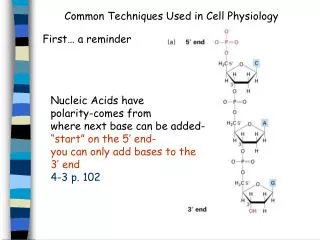
Common Techniques Used in Cell Physiology First… a reminder Nucleic Acids have polarity-comes from where next base can be added- “start” on the 5’ end- you can only add bases to the 3’ end 4-3 p. 102
Double stranded DNA (or RNA:DNA duplexes) are arranged antiparallel 5’ CAGT 3’ 3’ GTCA 5’ Often, only one strand is listed (Genbank)- this is conventionally the top strand (sense strand) and it reads 5’ 3’ left to right.
With this you can understand PCR-one of the most powerful and common techniques used in cell phys research today. Dr. Tom Brock- microbiologist looking for extremophiles- found Thermus aquaticus in Yellowstone hot springs-thriving at 70 C! Chien and Trella- Univ. Cincinnati first isolated DNA polymerase from Taq Kary Mullis- Cetus corporation-first figured out how to use Taq in PCR reaction Hoffman LaRoche- bought rights to PCR for 300 million
You can also use the same sort of idea to convert mRNA into DNA (cDNA) (7-15 p. 221)
Now you take each one of those pieces and clone it (view plasmid cloning animation)
Often each of these cloned cDNA is packaged into a virus-you then have a cDNA library 7-16,222
What’s a cDNA library good for? Say you are looking for a protein that shows up in liver during cancer. Make a cDNA library and screen it for this protein. 7-18, 225
If you are screening for DNA must have a probe (piece of complementary DNA that you think will stick to the right thing) You can also look for proteins in libraries 7-21, 228
Many of these techniques require that you know how the sequence of DNA at some stage of the game. You determine that (usually) with Sanger (dideoxy) sequencing 7-29,234
DNA microarrays (aka DNA chips) Fig. 7-39 p. 249 A relatively new method to screen thousands of genes simultaneously
Group Exercise #2 Look at the article I handed out (Lipshutz et. al, 1999. Nature Genetics. 21: 20-24 This is a complex article, but we can pull it apart In groups of 4: Group 1- How do you make a microarray? Group 2-How do you screen an array? Group 3-What are the applications for arrays?