Overview of Functional Groups: Carboxylic Acids, Esters, Amines, and Amides
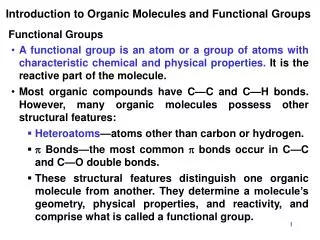
This guide explores the essential functional groups in organic chemistry, focusing on carboxylic acids, esters, amines, and amides. Each section details their general formulas, properties, uses, and naming conventions. Carboxylic acids (e.g., citric acid, lactic acid) are identified by their -oic acid suffix and weak acidic nature, while esters, recognizable by their pleasant aromas, adopt the -oate ending. Amines, which often present fishy odors, are categorized by their primary, secondary, and tertiary structures. Lastly, amides serve as crucial backbones for larger organic molecules like DNA and proteins.

Overview of Functional Groups: Carboxylic Acids, Esters, Amines, and Amides
E N D
Presentation Transcript
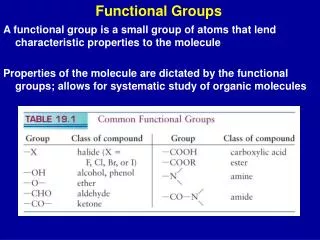
5) Carboxylic Acids General Formula:O ll R – C – OH (carboxyl group)
Properties & Uses • Weak acids • Found in edible substances i.e. Citric acid, aspirin; builds up in muscles: lactic acid
Naming Rules • -oic acid ending on parent chain • Functional grp gets lowest # in parent chain • Substituents named as always
Examples i.e. 5 – ehtylheptanoic acid Draw: Name:
Note: If this functional grp is drawn on the far left carbon, the OH is turned around and written as HO to show that the bond is between the C – O
6) Esters General Formula: O ll R – C – O – R'
Properties & Uses • Pleasant smells • Aromas in fruits
Naming Rules O ll R – C – O – R' • oate ending, named last -yl ending, named 1st • ***There is a space btn the names***
Examples Draw butyl propanoate Name the following: O ll CH3 – C – O – CH3
7) Amines General Formula: R – N – H l H • *Hs can be C chains • 3 types: 1o, 2o, 3o
Properties & Uses • Bad odours (fishy), weak bases • P69 for examples
Naming Rules • Amino prefixes the parent chain name • # in front of amino to indicate the location of the N on the parent chain • If there are C chains on the N, the letter N is placed in front of the substituent name (see examples below)
Examples Draw the following: • 2 – aminobutane • N – methyl – 3 – pentane • N – ethyl – N,3 – dimethyl-2-aminobutane
8) Amides • General Formula: O ll R – C – N – H l H *Hs can be replaced by C chains
Properties & Uses • Backbone for larger organic molecules like DNA and proteins
Naming Rules • Parent chain gets amide ending • C-chains on N are named the same as in amines
Examples Draw N- methylpentanamide Name: O ll CH3 – CH2 – C – N – CH3 l CH2 – CH3