
Moon Exploration: History, Surface, and Formation Theories
E N D
Presentation Transcript
28.2 The Moon
Reaching for the Moon • Much of our knowledge of the Moon comes from explorations by space probes and astronauts. • The first step was taken in 1957 with the launch of the first satellite, Sputnik I, by the Soviet Union.
Reaching for the Moon • In 1961, Soviet cosmonaut Yuri Gagarin became the first human in space. • The United States’ Project Mercury launched the first American, Alan Shepard Jr., into space on May 5, 1961.
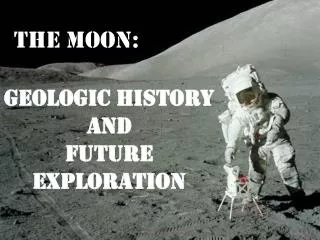
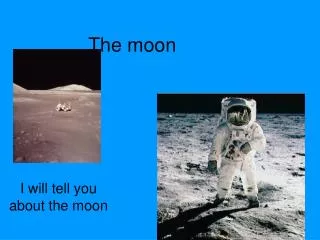
Reaching for the Moon • Project Gemini launched two-person crews into space, and on July 20, 1969, the Apollo program landed Neil Armstrong and Buzz Aldrin on the Moon, during Apollo 11.
Lunar Properties • The Moon’s radius is about 27% of Earth’s radius, and its mass is more than 1% of Earth’s mass. • Most moons are much smaller than this. • The Moons orbit is relatively farther from Earth than most moons are from the planets they orbit.
Lunar Surface • The albedo of the Moon, the amount of sunlight that its surface reflects, is very small (7%). • The sunlight that is absorbed by the surface of the Moon is responsible for the extreme differences in temperatures on its surface. • 127°C to -173°C
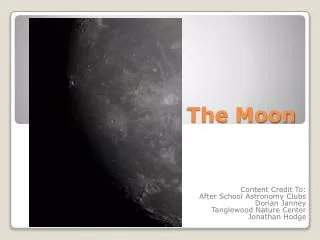
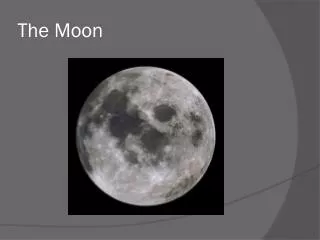
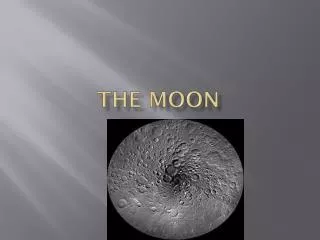
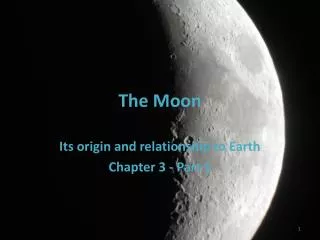
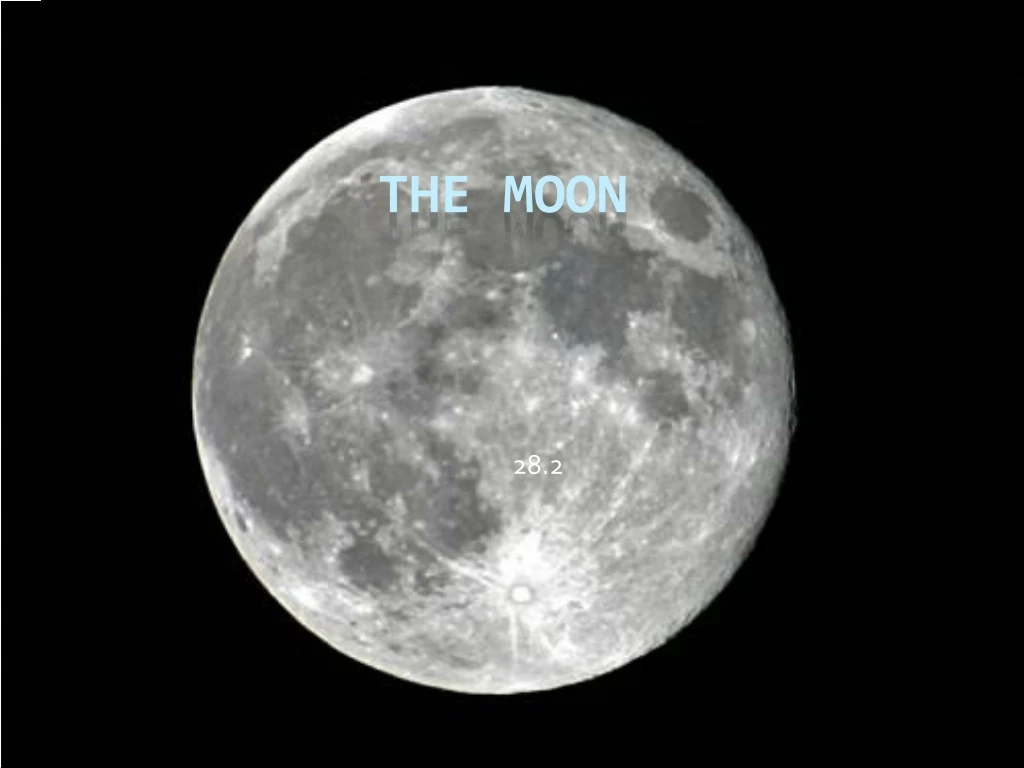
The Lunar Surface • There is no erosion on the Moon except for impacts. • The surface of the Moon consists of several features. • Regions called highlands are light in color, mountainous, and heavily covered with craters.
The Lunar Surface • Regions called maria (mare) are dark, smooth plains. • All of the craters on the Moon are impact craters, formed when objects from space crashed into the lunar surface. • The material blasted out during these impacts fell back to the surface as ejecta.
The Lunar Surface • Some craters have long trails of ejecta, called rays, that radiate outward. • Rilles are meandering, valleylike structures.
Composition • The Moon is covered in minerals similar to those of Earth, mostly silicates.
History of the Moon • The Moon is between 3.8 and 4.6 billion years old. • During its first 800 million years the Moon was heavily bombarded which resulted into forming a layer of loose, ground-up rock, called regolith on the surface of the Moon.
History of the Moon • After the bombardment, lava welled up from the Moon’s interior and filled in the large impact basins to form maria. • The Moon is twice as thick on the far side of the moon.
Tectonics on the Moon? • Scientists infer from seismometer data that the Moon, like Earth, has a layered structure, which consists of the crust, the upper mantle, the lower mantle, and the core. • The Moon experiences a moonquake once a year, but scientists theorize that the Moon is not tectonically active.
Formation Theories • The capture theory proposes that as the solar system was forming, a large object ventured too near to the forming Earth, became trapped in its gravitational pull, and formed into what is now the Moon. • The problem with that is that something would have to slow it down, and the moon and earth would have difference compositions.
Formation Theories • Another theory, called the simultaneous formation theory says the Moon and Earth formed at the same time and in the same general area which makes the materials the same. • This theory does not account for the different amounts of iron on Earth and on the Moon.
Formation Theories • The most commonly accepted theory of how the Moon formed, the impact theory. • The Moon formed as the result of a gigantic collision between Earth and a Mars-sized object about 4.5 billion years ago, when the solar system was forming.
Formation Theories • As a result of the collision, materials from the incoming body and from Earth’s outer layers were ejected into space, where they merged together to form the Moon.