Understanding Earth’s Structure: Layers, Composition, and Importance
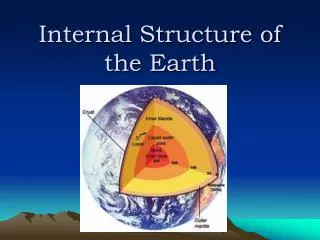
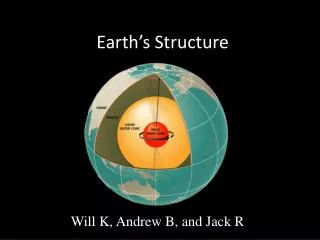
Explore the fascinating structure of Earth, which consists of the core, mantle, and crust. The core is a hot metallic sphere, with temperatures reaching 5,000 degrees Fahrenheit; the inner core remains solid while the outer core is a liquid. The mantle, a thick rocky layer, can flow and has a temperature of around 3,300 degrees Fahrenheit. The crust is a thin layer of rocks and minerals surrounding the mantle. This discovery of Earth’s layers highlights the importance of geology in understanding our planet’s surface and atmosphere.

Understanding Earth’s Structure: Layers, Composition, and Importance
E N D
Presentation Transcript
Earth’s Structure Will K, Andrew B, and Jack R
Earth’s Core Core: a sphere of hot metal at the center of Earth 5,000 degrees Fahrenheit Inner core is solid, but the outer core is hot liquid metal
Mantle • Mantle: Thick rocky layer around the core • 3,300 degrees Fahrenheit • Solid but able to flow
Crust • Crust: Thin layer of rocks and minerals that surrounds the mantle • Thin in the ocean • Thick under mountains • Heat and movements in the mantle change the formation of the crust
Earth’s Atmosphere • Atmosphere: a thicklayer of gases in the air • Holdsheatfromthesun • Thismakeslifepossible
Water • Makes up 75% of Earth • 97% isOcean • 3% isfreshwater
Land • Landforms: shapes and types of land • Make up 25% of Earth • Landformsincludemountains, volcanoes, and plains
Work Cited "5 Oceans of the World." , List, News, What You Should Know. Bear Systems Publishing, n.d. Web. 16 Sept. 2013. BarisSimsek. "First Measurement of Magnetic Field in Earth's Core." ScienceDaily. ScienceDaily, 19 Dec. 2010. Web. 13 Sept. 2013. BBC News. BBC, n.d. Web. 16 Sept. 2013 "Bēhance." Behance. BBC, n.d. Web. 13 Sept. 2013. Chu, Gregory H., Susan Hardwick, Don Holtgrieve, and Grant P. Wiggins. "Earth's Structure." Pearson My World Geography :. Boston, MA: Pearson, 2011. 22-23. Print. "Desert Ecology of Tucson, AZ." Desert Ecology of Tucson, AZ. N.p., n.d. Web. 16 Sept. 2013. "Earth’s Atmosphere: The Tropopause and the Troposphere." Artinaid. N.p., Apr. 2013. Web. 16 Sept. 2013. Herndon, J Marvin. "No Earth-Core Convection." No Earth-Core Convection. N.p., n.d. Web. 16 Sept. 2013. Kerls, Brian. "Mountains + Landscapes." Brian Kerls Photography RSS2. N.p., n.d. Web. 16 Sept. 2013. "Layers of the Atmosphere Mouseover the Pictures and Scroll down to Learn More." Layers of the Atmosphere. N.p., n.d. Web. 16 Sept. 2013. "Mantle Convection." Wikipedia. Wikimedia Foundation, 16 Sept. 2013. Web. 16 Sept. 2013. "Nature’s Water Cycle « The Underspace - Home of Underground Focus Magazine." The Underspace Home of Underground Focus Magazine RSS. N.p., 22 Oct. 2012. Web. 16 Sept. 2013. "Transit of Venus, Sun-Earth Day 2012." Earth:. NASA, n.d. Web. 12 Sept. 2013 Whitwam, Ryan. "ExtremeTech." ExtremeTech. N.p., 3 Oct. 2012. Web. 16 Sept. 2013.