Understanding Cardiac Conduction: The Role of Specialized Muscle Cells**
80 likes | 205 Vues
This text explores the intricate conduction system of the heart, highlighting the roles of specialized cardiac muscle cells, including contractile and autorhythmic cells. It details the process of action potential initiation and conduction, including the spread of excitation through atrial and ventricular pathways. Key delays, such as the AV nodal delay, are discussed, along with the mechanisms of action potentials in contractile cells: rising phase, plateau phase maintained by L-type Ca2+ channels, and the return to resting potential through K+ channels. The dynamics of cardiac muscle contraction are vital for effective heart pumping.


Understanding Cardiac Conduction: The Role of Specialized Muscle Cells**
E N D
Presentation Transcript
5 6 1 7 2 3 4 8
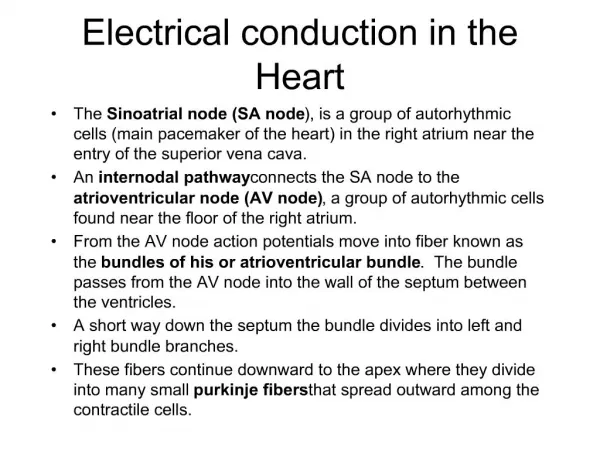
Specialised cardiac muscle cells • Contractile cells • Mechanical work of pumping • Autorhythmic cells • Initiating and conducting action potentials
Autorhythmic cells Cardiac contractile muscle cells
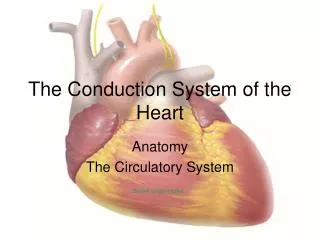
Spread of excitation • Atrial excitation • Interatrial pathway • Internodal pathway (~30ms to reach AV node) • Conduction between the atria and the ventricles • AV nodal delay (~100ms) • Ventricular excitation • Bundle of His • Purkinje fibres (~30ms delay)
Action potential of contractile cells • Rising phase • Activation of VG-Na+channels • Na+ rapidly enters the cell • Plateau phase • Maintained by 2 voltage-dependent permeability channels • Activation of ‘slow’ L-type Ca2+ channels • Marked decrease in K+ permeability • Occur due to the sudden change in voltage during the rising phase of the action potential
Action potential cont’d • Falling phase • Inactivation of Ca2+ channels • Delayed activation of VG-K+ channels • Returns resting potential to polarisation