Swimring: A Fun New Water Sport Promoting Healthy Activity for Kids
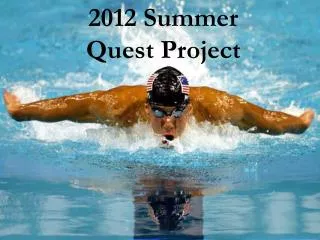
This summer, I created Swimring, an exciting water sport inspired by the 2012 Summer Olympics and my experience on the Highland swim team. With childhood obesity on the rise in the U.S., Swimring aims to keep children active and healthy while having fun. The objective is to swim across a pool, passing through strategically placed rings, while minimizing penalties for touching them. By engaging kids in Swimring, they can burn approximately 200 calories in just half an hour, promoting a healthier lifestyle through enjoyable play.

Swimring: A Fun New Water Sport Promoting Healthy Activity for Kids
E N D
Presentation Transcript
2012 Summer Quest Project
For my Q.U.E.S.T project this summer, I created a water sport called “Swimring.’’ My inspiration for creating this sport was the 2012 Summer Olympics, my participation on the Highland swim team, and my realization of the high child obesity prevalence in the U.S. My goal was to create a sport that was fun and moderately difficult to keep children active and healthy. Objective: To swim across a pool, while going through rings, in the best time possible. Penalty: If you touch a ring while passing through it, two seconds are added to your time.
How to Create Swimring in your own Pool… • Fill plastic bags with rocks or water • Attach thin string, at any length to each bag • Attach the other end of the string to a hoola-hoop • Place the hoops in the water in any position you want (depending on the difficulty of the course you would like)
____ Hoola-Hoop ___ Thin string Plastic bag (filled with rocks/water) ____
Calculations: By playing swimring for half an hour an average 13 year old could burn about 200 calories
BMI is a number calculated from a child's weight and height, and reported as kg per meter squared. • BMI is an easy way of screening for weight problems.
When a BMI is calculated for a child or adolescent, their number is plotted on a BMI growth chart to find a percentile ranking. • Percentiles assess the size and growth patterns of children in the U.S. • The percentile indicates were a child's BMI number stands among children of the same gender and age. • These charts show the weight status of children and teens. • There are four categories, underweight, healthy weight, overweight, and obese.
http://discoveryhealthcme.dicovery.com http://www.fitday.com/webfit/burned/calories_burned Swimming_laps_freestyle_fast_vigorous_effort.html Sources: http://www.google.com/imgres?q=map+of+us+child+obesity&start=254&um=1&hl=en&biw=1280&bih=664&tbm=isch&tbnid=ENbAQ7d39uyQDM:&imgrefurl=http://www.cdc.gov/ http://www.halls.md/body-mass-index/overweight.htm http://www.cdc.gov/healthyweight/assessing/bmi/childrens_bmi/about_childrens_bmi.html http://www.google.com/imgres?q=bmi+for+children+chart&um