The Rise of Alexander the Great: From Philip's Death to the Battle of Granicus (336-334 BCE)
This overview chronicles the initial phase of Alexander the Great's reign, beginning with the assassination of his father, King Philip II of Macedon, in 336 BCE. Following Philip's death, Alexander swiftly navigates the treacherous political landscape, quelling unrest in Greece, subduing rebellious tribes, and garnering support for military campaigns against Persia. Notably, the narrative culminates in the Battle of Granicus River in 334 BCE, where Alexander's forces successfully confront the Persians, marking a significant step in his quest for empire and the spread of Hellenic culture.


The Rise of Alexander the Great: From Philip's Death to the Battle of Granicus (336-334 BCE)
E N D
Presentation Transcript
Alexander the Great From the beginning of his reign (336 BCE) to the Battle of the GranicusRiver (334 BC)
Death of Philip • Philip murder by Pausanius, a disgruntled lover, in 336 BC • Sikander and Halil (1999) argue that a complex grouping of Persians; the Macedonian generals, Attalus and Parmenion; and a branch of the Macedonian royal family – the sons of Aeropus, may have been behind Pausanius.
Reign of Alexander begins • Macedonian nobles vote on the succession to Philip • Attalus, father of Philip’s second wife, Cleopatra-E, sponsored his infant grandson, Karanos, as a claimant to the throne. • Attalus was murdered on the orders of Alexander. Cleopatra-E and Karanos were murdered on the orders of Olympias.
Alexander in Greece 335 BCE • Alexander made a lightning march through central Greece to quell unrest, force recognition of him as his father’s successor, take over as commander-in-chief of the League of Corinth, gain support for plans against the Persians (first developed by Philip).
Alexander in Greece BCE • Restless tribes of Thrace and Illyria subdued • Demosthenes stirred up trouble in Athens. Thebans killed the Macedonian garrison. Alexander sacked Thebes and razed it to the ground. Thebans either killed or sold into slavery. Athens and Demosthenes treated leniently.
The Persian Expedition • Debate about objectives of Alexander’s expedition against the Persians: • Asia Minor?; Persia?; the world? • Revenge? Exploration? Scientific research? Spread of Hellenic culture?
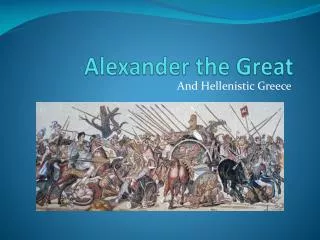
The Battle of the Granicus River, 334 BCE • Persians waited on the far side of the GranicusRiver • Alexander’s army crossed the deep and flowing river • Greek mercenaries who had fought for the Persians were butchered
The Battle of the Granicus River, 334 BCE • Results: prisoners; spoils; appointment of Macedonian governor; liberation of some of the Ionian Greeks