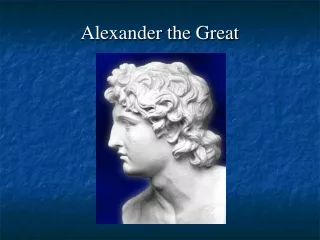
Alexander the Great
190 likes | 335 Vues
Explore the remarkable journey of Alexander the Great, from the unification of Macedonia under Philip II to his astonishing military campaigns that expanded his empire from Greece to India. Learn how Alexander's leadership and innovative battle tactics transformed Macedonia into a formidable power. Delve into the cultural exchanges that characterized Hellenistic Greece, marked by significant advancements in science and philosophy. Despite his achievements, the lack of an heir led to the empire’s fragmentation post-Alexander, culminating in internal conflicts among his generals.


Alexander the Great
E N D
Presentation Transcript
Alexander the Great And Hellenistic Greece
Macedonians • Live north of the Greek peninsula and even spoke a Greek dialect • Most Macedonians were farmers and shepherds, so they had not achieved the same cultural feats as the Greeks
Macedonians • By the 4th century BCE the people of Macedonia were united because of the work of several kings • This transformed the country into a military power to be reckoned with
Philip II • Ruled Macedonia until 336BCE • Was considered the most brilliant of Macedonia’s kings • Discovered gold deposits and gained enough wealth to assemble a massive army
Thebes • In 338BCE at the battle of Chaeronea near Thebes the forces of Macedonia defeated the Greek city-states and amalgamated them into Macedonia
Macedonia Army • Was strong due to two primary factors • The phalanx formation • Well-trained cavalry
Assassinated! • In 336BCE, one of Philip’s body guards assassinated him • Philip’s son Alexander was proclaimed king of Macedonia
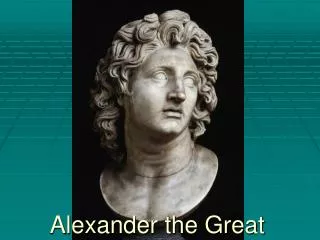
Alexander the Great • Alexander was a cavalry officer in wars with the Greek states and had proven himself as a military leader • After being announced kin, Alexander had any rivals murdered and launched military campaigns to show his military strength • Thebes had tried to revolt, so Alexander had 6000 citizens executed and sold the rest into slavery
11 Year Campaign • Alexander wanted to complete his father’s plans to conquer Egypt, Persia, Mesopotamia, and India • Within one year Alexander had already conquered the Persian Empire
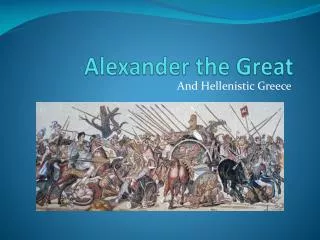
Hydaspes • In 327 BCE, 30 000 of Alexander’s troops moved into India • But, Alexander’s cavalry became virtually immobilized by the Indian elephants • The battle of Hydaspesended in a victory for Alexander • But, his men were ready to mutiny so Alexander turned back to head home
Marching Home • The Greek forces went south down the Indus river, marched along the Persian Gulf, and entered Babylon • Alexander died at Babylon in 323BCE of either typhoid or malaria
Hellenistic Greece • Alexander’s campaigns resulted in an increased cultural exchange for the Greek civilization from both the east and the west • Alexander had used men from all over his empire in his army, so troops became quite cosmopolitan • Alexander’s empire also stretched from Greece to India with lots of interaction between different people:
Hellenistic Greece • Alexander wanted to make Greek culture and language the unifying factor in his empire • But, he was too pluralistic and respected the laws and customs of conquered peoples • He even allowed officials in conquered territories to maintain administration rights
Hellenistic Greece • Important scientific and philosophical advancements: • Euclid made advancements in geometry • Archimedes made advancements in physics • Aristarchus formulated the heliocentric view of the universe • Stoicism developed • People believe humans should always be honourable
Crumbling Empire • Alexander had no children, so there was no heir to his throne • As a result, his generals fought for power for 40 years • The Macedonian Empire became several large states each ruled by a descendent of a general • The Greek mainland was not peaceful until the Roman conquest in 27BCE
Quick Review “Alexander the Great and the Situation” – CrashCourse Turn to pg. 122 and complete questions 1-3