Download
1 / 10
100 likes | 228 Vues
This resource engages students in comparing different transverse stationary waves. Objectives include predicting air molecule displacements, methods for recording fundamental frequency (f0), and evaluating data pertinent to transverse stationary waves. Students will design experiments to create these waves and explore how various conditions and shapes affect their formation. The session also addresses why transverse and longitudinal waves behave differently and subsequently helps students summarize findings on wave properties. Interactive group activities foster collaborative learning and differentiation.

E N D
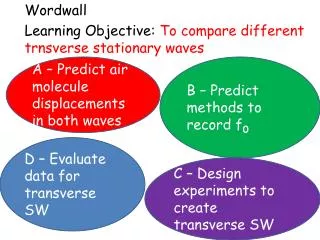
Wordwall Learning Objective: To compare different trnsverse stationary waves A – Predict air molecule displacements in both waves B – Predict methods to record f0 D – Evaluate data for transverse SW C – Design experiments to create transverse SW
Why do guitars work? Why are we learning this? The 2 types of stationary wave create All types of music – simple To complex
A’s B’s Define f0 Analyse how f0, 2f0 and 3f0 look Summarize Assess whattranverse transverse SWstationary f0 depends onwaves Compare Predict what a Transverse SW longitudinal and normal transverse stationary wave is waves
Wordwall which is true? F0 has 2 nodes and antinodes F0 has 1 node and antinode F0 has no nodes but an antinode Transverse SW particles don’t moveTransverse SW waves progress (move on) Transverse SW particles move but waves don’t progress (move on) Longitudinal SW particles don’t moveLongitudinal SW waves progress (move on) Longitudinal SW particles move but waves don’t progress (move on)
So what would we need to create a transverse stationary wave? Be as vague as possible, and then give an example Conditions needed: Shape needed: A transverse wave can only reflect at a node EXT: Why won’t you ever see a transverse stationary wave of frequency f0/2
Wordwall Learning Objective: To compare different trnsverse stationary waves A – Predict air molecule displacements in both waves B – Predict methods to record f0 D – Evaluate data for transverse SW C – Design experiments to create transverse SW
So what would we need to create a transverse stationary wave? Be as vague as possible, and then give an example Conditions needed: Shape needed: A transverse wave can only reflect at a node EXT: Why won’t you ever see a transverse stationary wave of frequency f0/2
With reasons… (C) Work through q2 p161 Describe 3 ways to create a transverse stationary wave with reasons (B) How can you test what f0 is? Complete q3 p161 (A) Using p162 prepare a 2 minute summary of longitudinal stationary waves
Wordwall Learning Objective: To compare different trnsverse stationary waves A – Predict air molecule displacements in both waves B – Predict methods to record f0 D – Evaluate data for transverse SW C – Design experiments to create transverse SW
Games! #CREATE RESOURCES for Group work, plus differentiation For A work