Understanding Atoms, Bonds, and Ionic Compounds in Chemistry
This resource covers essential concepts in chemistry, focusing on the total number of atoms in compounds such as Al3(SO4) and H2(SO3)2, as well as the types of chemical bonds formed between elements. It explains ionic and covalent bonds, highlighting electron transfer versus sharing. Students will learn to calculate electronegativity differences, determine bond polarity, and apply the Kriss-Kross method for writing ionic compounds. This comprehensive guide provides foundational knowledge necessary for success in chemistry classes.

Understanding Atoms, Bonds, and Ionic Compounds in Chemistry
E N D
Presentation Transcript
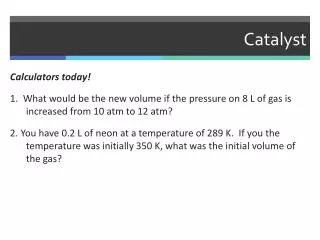
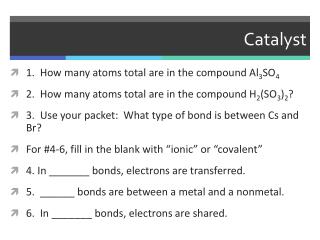
Catalyst • 1. How many atoms total are in the compound Al3SO4 • 2. How many atoms total are in the compound H2(SO3)2? • 3. Use your packet: What type of bond is between Cs and Br? • For #4-6, fill in the blank with “ionic” or “covalent” • 4. In _______ bonds, electrons are transferred. • 5. ______ bonds are between a metal and a nonmetal. • 6. In _______ bonds, electrons are shared.
Example • Determine the type of bond in HF • Find electronegativity of each atom
Example • Determine the type of bond in HF • Find electronegativity of each atom H = 2.2 Paulings, F = 4.0 Paulings
Example • Determine the type of bond in HF • Find electronegativity of each atom H = 2.2 Paulings, F = 4.0 Paulings • Find Electronegativity Difference (∆EN) DEN = 4.0 – 2.2 = 1.8 • Look at chart to determine bond type.
Example • Determine the type of bond in HF • Find electronegativity of each atom H = 2.2 Paulings, F = 4.0 Paulings • Find Electronegativity Difference (∆EN) DEN = 4.0 – 2.2 = 1.8 • Look at chart to determine bond type. Bond Type: Ionic
Remember how there are different types of covalent bonds?...
Bond Polarity Bond polarity is based on differences in electronegativities of atoms forming a bond • As electronegativity difference (∆EN) increases, polarity of bond increases
Pure Ionic Bonding • Total give and take (transfer) of electrons! = Big ∆EN! I have no chance!
Covalent Bonding is like a Tug-of-War • The more electronegative atom will pull electrons harder
Polarity and Electronegativity • Polar bonds - electrons are pulled more toward one of the atoms Big ∆EN! • Nonpolar bonds - electrons are shared equally between atoms Low ∆EN! Big Dog – Little Dog Medium Dog – Medium Dog
How Polar Is It? • Determine the polarity of each bond in the following compounds by calculating the electronegativity difference for each: • CO 5. HF • AlP6. CaO • N2 7. H2 4. SiO 8. NF3
Stable Charges • Atoms can only bond if they are ions…. • Certain atoms prefer to have certain charges… • They prefer to act like noble gases and have the same electrons as noble gases…
The Octet Rule - Review An atom that has gained an electron has a negative charge An atom that has lost an electron has a positive charge How can we know what charge it will have? Let’s talk about Lithium…..
Stable Charges • Finding the stable charge: Count to the closest Noble Gas. If you count backwards, the charge is positive. If you count forwards, the charge is negative. • Li • Br • Ca • P 2:00 1:59 1:58 1:57 1:56 1:55 1:54 1:53 1:52 1:51 1:50 1:49 1:48 1:47 1:46 1:45 1:44 1:43 1:42 1:41 1:40 1:39 1:38 1:37 1:36 1:35 1:34 1:33 End 1:32 1:30 1:29 1:28 1:27 1:26 1:25 1:24 1:23 1:22 1:21 1:20 1:19 1:18 1:17 1:16 1:15 1:14 1:13 1:12 1:11 1:10 1:09 1:08 1:07 1:06 1:05 1:04 1:03 1:02 1:01 1:00 0:59 0:58 0:57 0:56 0:55 0:54 0:53 0:52 0:51 0:50 0:49 0:48 0:47 0:46 0:45 0:44 0:43 0:42 0:41 0:40 0:39 0:38 0:37 0:36 0:35 0:34 0:33 0:32 0:31 1:31 0:30 0:28 0:27 0:26 0:25 0:24 0:23 0:22 0:21 0:20 0:19 0:18 0:17 0:16 0:15 0:14 0:13 0:12 0:11 0:10 0:09 0:08 0:07 0:06 0:05 0:04 0:03 0:02 0:01 0:29 2:00
Stable Charges • An ion is stable when it has the electron configuration of a noble gas (8 valence electrons)
Once they have a charge, they want to combine with other ions… There is a trick to figuring this out…
Ca2+As3- Kris Kross Method! Ca3As2
KrissKross Method • KrissKross Method: Write down the stable ions and cross the charges to make them subscripts • Exception: When the numbers are the same, they cancel out. Na1+Cl1- NaCl Li1+O2- Li2O
Which charge ALWAYS comes first? POSITIVE!!
1. K F 2.BaN 3. Na O 4. Ca Cl 5. K Si 6. Co I
K1+F1- Ba N Na O CaCl K Si Co I
K1F1Ba N Na O Ca Cl K Si Co I
KF Ba N Na O Ca Cl K Si Co I
1. K F 2.BaN 3.Na O 4. Ca Cl 5. K Si 6. Co I
KF Ba2+N3- Na O CaCl K Si Co I
KF Ba3N2 Na O CaCl K Si Co I
KF Ba3N2 Na1+O2-CaCl K Si Co I
KF Ba3N2 Na2OCaCl K Si Co I
KF Ba3N2 Na2O Ca2+Cl1- K Si Co I
KF Ba3N2 Na2OCaCl2 K Si Co I
KF Ba3N2 Na2OCaCl2 K1+Si4- Co I
KF Ba3N2 Na2OCaCl2 K4Si Co I
K F Ba N Na O CaCl K Si Co I You don’t know about transition metals! So.. the problem must tell you the number of electrons. Cobalt (II) means that Cobalt gives up 2 electrons
K F Ba N Na O CaCl K Si Co2+I1-
K F Ba N Na O CaCl K Si CoI2
Independent Practice For each pair find the STABLE ION and then Kris Kross! 1. Mg O 2. Na Br 3. Rb P 4. Be F 5. CaS 6. K Cl 7. Li N 8. Cu (III) O
Exit Slip 1. Use the kriss-kross method to write the correct ionic compound for Ca and Cl 2. What is the ionic compound formed by Mg and N? • Mg2N3 • MgN2 • Mg3N2 3. Use the kriss-kross method to write the stable ionic compound for Al and Br. 4. True or false: The stable ion formed by Al is Al2+. 5. Which of the following is an incorrect match between the element and its stable charge? • N, -3 • Ba, +2 • F, +1 d. Br, -1