Classification of Matter
140 likes | 253 Vues
This chapter focuses on the classification of matter into substances, including elements and compounds. It explains the definitions and differences between heterogeneous and homogeneous mixtures, with examples like air, sugar water, and concrete. Key concepts such as physical properties, methods for separating mixtures, and chemical properties are covered. The chapter emphasizes the law of conservation of mass, which states that mass is conserved in chemical reactions. Understanding these concepts is vital for studying chemistry and the behavior of different materials.


Classification of Matter
E N D
Presentation Transcript
Classification of Matter Chapter 15
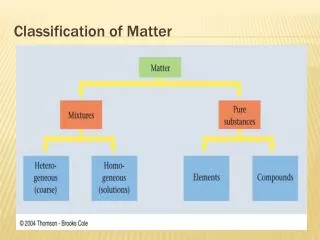
Composition of Matter – Sec. 1 • ________________ Substances • Same composition throughout • Either an ___________________ or compound • Element • All _____________ type of atom • Everything made of _____________________ • Compound • Atoms of two or more elements __________________________ bonded together
Composition of Matter • ________________ • Made of two or more substances that can be easily separated by ________________ means • Heterogeneous Mixture • ________________ materials can be seen easily • _____________ , concrete, vegetable soup • Homogeneous Mixture (Solution) • Blended ________________ throughout • ____________, Kool-aid
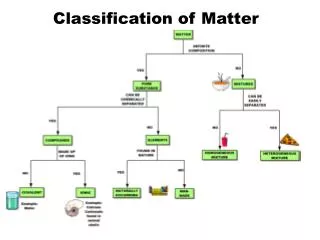
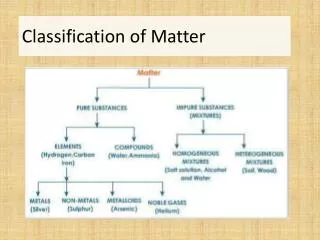
MATTER Can it be separated? no yes Mixture Air, sugar water, stainless stell Mixture Granite, wood, blood Water, sodium chloride Gold, aluminum
Mixtures • __________________ ~ heterogeneous • Particles larger than solution but __________ heavy enough to settle out • Milk, paint, fog and ______________ • Detecting Colloids • Pass a beam of light through it • Colloid – ____________ beam • ____________________ – Cannot see beam • Particles big enough to scatter light – ________________ Effect
Mixtures • ___________________ ~ heterogeneous • Not solution, not colloid • Muddy _______________ water • Heterogeneous mixture with a liquid and visible particles that _________________
Properties of Matter Section 2
Physical Properties • Def: characteristic observed _________________ changing the identity of the material • Ex: color, ______________, size, density • Appearance • _________________ • Magnetic, malleable, flow of liquid
Separating Mixtures • Sand and Rock mixture? • Filter or _______________ • Iron filings and Aluminum mixture? • ________________
Physical Change • Change in _____________, shape or state of matter and identity is same • Solid to a liquid? • __________
Gas Liquid Solid
Physical Change • How to get pure water from salt water? • ____________________ – evaporate liquid and then recondense it
Chemical Properties and Changes • Chemical Property – can be observed only by ______________ the substance • Flammability, reactivity, decomposition • Chemical Change – change where a __________ substance is formed • Weathering – Physical or Chemical Change? • ___________
Law of Conservation of Mass • Matter is neither _______________ nor destroyed during a chemical reaction • Mass of all substances _____________ = mass of all substances after change