

SlideServe
Menu
Préférences
© SlideServe · v2026

The Middle Ages

dennis avatar
79 diapositives · 1K Views · Jul 13, 2014

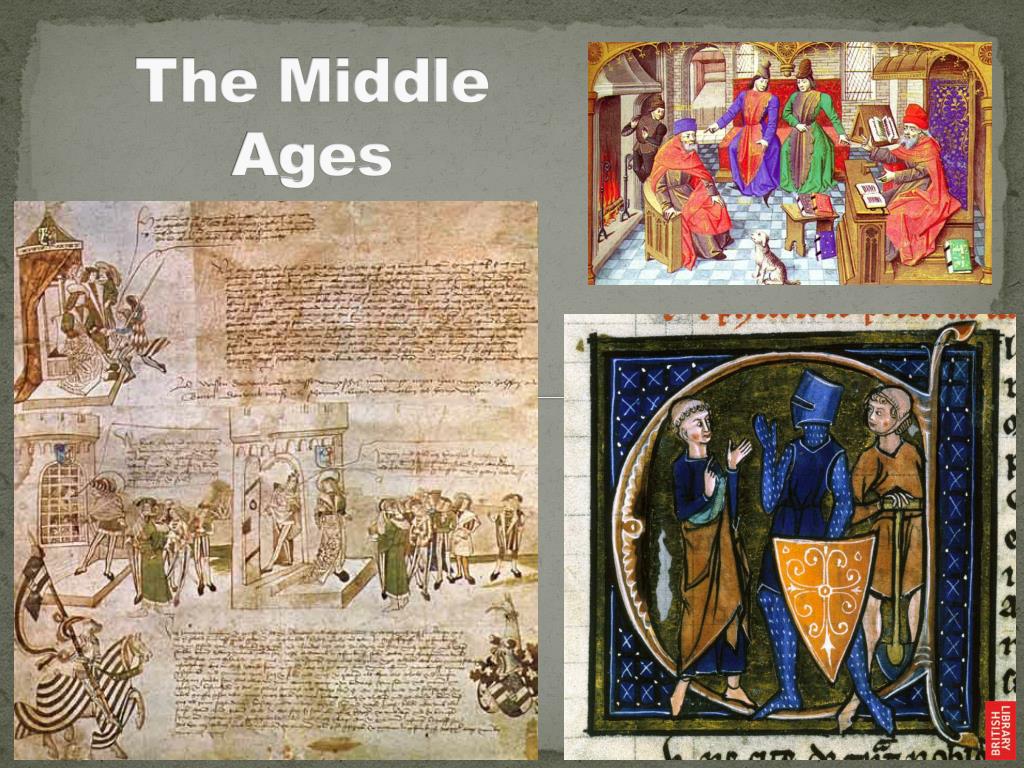
The Middle Ages. 1. What were the Middle Ages?. Lasted from 500 – 1500 Germanic groups invaded Roman Empire Trade was disrupted People returned to rural ways of life People were less educated Monasteries preserved knowledge . 2. Who were the Franks?.
The Middle Ages - slide 1
01 / 79The Middle Ages
1 / 17

Télécharger la présentation

The Middle Ages
Une image / un lien ci-dessous est fourni (tel quel) pour télécharger la présentation

Politique de téléchargement : le contenu du site vous est fourni TEL QUEL pour votre information et votre usage personnel ; il ne peut être vendu, concédé sous licence ni partagé sur d’autres sites sans l’accord de son auteur.Le contenu vous est fourni TEL QUEL, pour votre information et votre usage personnel uniquement. Téléchargez la présentation en cliquant sur ce lien. Lors du téléchargement, si vous ne parvenez pas à télécharger une présentation, l’éditeur a peut-être supprimé le fichier de son serveur.Pendant le téléchargement, si vous ne parvenez pas à obtenir une présentation, le fichier a peut-être été supprimé par l’éditeur.

F I N

Plus de contenu associé

Transcription de la présentation
  1. The Middle Ages

  2. 1. What were the Middle Ages? • Lasted from 500 – 1500 • Germanic groups invaded Roman Empire • Trade was disrupted • People returned to rural ways of life • People were less educated • Monasteries preserved knowledge

  3. 2. Who were the Franks? • A Germanic tribe of nomads who lived in the Rhine River Valley. • In the 400s, the Franks began to invade Roman Gaul (France today)

  4. 3. Who was Clovis I? • Merovingian King of the Franks from 481-511 • He was Pagan, but In 496 his wife (Clothilde) convinced him to convert to Christianity • The rest of his people then converted

  5. 4. Who was Charles Martel? • “Charles the Hammer” • Carolingian who became Mayor of the Palace in 714 • Defeated the Muslims in 732 at the Battle of Tours

  6. 5. What was the significance of The Battle of Tours? • Ended the Muslim threat to Europe (except for Spain) • Showed the effectiveness of cavalry (used by Muslims) • Led to the importance of knights

  7. 6. Who was the first King of the Franks? • Pepin the Short (son of Charles Martel) • Convinced Pope Boniface to crown him King of the Franks (751) • Pepin created the Papal States when he gave part of his territory to the Pope • Ended all rule of the Merovingians and began the Carolingian Dynasty

  8. 7. Who was Charlemagne? • “Charles the Great” • Son of Pepin • 771 – King of the Franks • Created the largest kingdom in Europe since ancient Rome • Pope Leo III crowned him King of the Romans • (Cont.)

  9. 7. Who was Charlemagne? (Cont.) • Paid for a revival of learning - the Carolingian Renaissance • Monks copied Roman manuscripts • Opened schools • His empire was divided between his three sons who fought each other until 843 – signed the Treaty of Verdun

  10. Treaty of Verdun

  11. 8. Why did Feudalism Rise? • Increasing violence and lawless • Vikings attacked from the north • Magyars (Turkish nomads) attacked from the east • Muslims attacked from the south • People had no central government to protect them • People turned to lords for protection

  12. Feudal System • King • Vassals – Nobles and Bishops who were wealthy land owners • Knights – defended Vassals’ land in exchange for fiefs (land) • Peasants – worked the Vassals’ fields; many were serfs who could not leave the land

  13. 9. What political power did the Pope have? • Popes often crowned the Kings. • All Christian Kings had to have the Pope’s blessing. • Excommunication – if the Pope was unhappy with a King, they could be excommunicated and condemned to hell. • The Church could put anyone on trial who violated Canon (Church) law.

  14. 10. How did farming change? • The climate was warmer from 800 to 1200 • Farmers used a new type of harness that fit across a horse’s chest – horses could pull plows • Farmers could grow more crops when they switched from a two-field system to a three-field system

  15. 11. What financial and trade changes took place? • The Church forbade Christians from lending money at interest – Jews became the source for loans. • Trade increased and towns grew larger and more crowded.

  16. 12. What changes took place in literature and learning? • Authors began writing in the vernacular – brought literature to many people • Christian scholars from Europe visited Muslim libraries • Many Greek writings were translated into Latin. • Ancient writings influenced Christian writers.

  17. The Church Wields Power

  18. Church Reform and the Crusades

  19. A new age of spiritual feeling arose in Europe in the 1000s The Age of Faith

  20. Many problems troubled the Church so Popes made reforms Ended marriage of Priests and Simony

  21. Huge churches were built in the Gothic style architecture. Towering cathedrals with stained-glass windows (ex. Notre Dame)

  22. The First Crusade

  23. 1093 – the Byzantine emperor asked for help against the Muslim Turks Needed to protect Constantinople.

  24. Pope Urban II urged leaders in Europe to begin a Crusade - 1095 He wanted to take control of Jerusalem and the Holy Land from the Seljuk Turks

  25. The First Crusade - 1096 Crusaders captured Jerusalem.

  26. The Second Crusade

  27. The Second Crusade - 1187 Saladin recaptured Jerusalem.

  28. The Third Crusade - 1192 Richard the Lion-Hearted fought Saladin Came to a truce – Saladin opened Jerusalem to Christian pilgrims

  29. The Fourth Crusade

  30. The Fourth Crusade – 1202-1204 Knights attacked and looted the Christian cities of Zara and Constantinople

  31. The Reconquista Drove the Muslims out of Spain.

  32. The Inquisition People suspected of heresy were questioned, tortured, and executed.

  33. The Rack

  34. The Wheel

  35. The Stake

  36. The Iron Maiden

  37. The Pear of Anguish

  38. Rat Torture

  39. The Head Crusher

  40. The Saw

  41. The Knee Splitter