### Understanding Deadlocks: Detection, Prevention, and Recovery Strategies ###
This chapter delves into the intricacies of deadlocks in computer systems as explored by Dr. Hengming Zou. It presents essential concepts such as resource allocation, the conditions for deadlock occurrence, and various methods for detection, prevention, and recovery. The chapter examines scenarios like the Dining Philosophers Problem to illustrate how deadlocks can arise and how to prevent them. It also discusses strategies including ignoring the problem, detection through wait-for graphs, and recovery via preemption or process termination. A comprehensive guide for students and professionals. ###

### Understanding Deadlocks: Detection, Prevention, and Recovery Strategies ###
E N D
Presentation Transcript
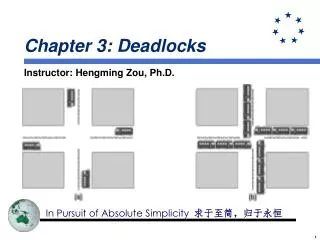
Chapter 3: Deadlocks Instructor: Hengming Zou, Ph.D. In Pursuit of Absolute Simplicity求于至简,归于永恒
Content • Resource • Deadlocks • Deadlock modeling • Deadlock detection and recovery • Deadlock avoidance and prevention
Resources • Something needed by a thread • A thread waits for resources • Examples of computer resources • Printers, tape drives, tables, • locks, disk space, memory, CPU
Resources • Processes need access to resources • in reasonable order • Preemptable resources • can be taken away from a process with no ill effects • Nonpreemptable resources • will cause the process to fail if taken away
Resources • Suppose a process holds resource A • and requests resource B • At same time another process holds B • and requests A • both are blocked and remain so • Deadlock!
Resources • Sequence of events required to use a resource • request the resource • use the resource • release the resource
Resources • Must wait if request is denied • requesting process may be blocked • may fail with error code
Deadlocks • A circular waiting for resources • leading to threads involved not being able to make progress • Deadlocks occur when… • processes are granted exclusive access to resources
Deadlocks • Formal definition: • A set of processes is deadlocked if: • each process in the set is waiting for an event that only another process in the set can cause • Usually the event is release of a held resource
Deadlocks • In a deadlock, none of the processes can … • run • release resources • be awakened
Deadlocks • General structure of thread code • phase 1. while (not done) { • acquire some resources • work • } • phase 2. release all resources • Assume phase 1 has finite amount of work
Deadlocks • Example thread A thread B lock(x) lock(y) lock(y) lock(x) ... ... unlock(y) unlock(x) unlock(x) unlock(y)
Deadlocks • Can deadlock occur with code? • Will deadlock always occur with this code?
Dining Philosophers • 5 philosophers sitting around a round table • 1 chopstick in between each pair of philosophers • 5 chopsticks total • Each philosopher needs two chopsticks to eat • How to prevent deadlock
Dining Philosophers • Algorithm for each philosopher • wait for chopstick on right to be free, then pick it up • wait for chopstick on left to be free, then pick it up • eat • put both chopsticks down • Can this deadlock?
Conditions for Deadlock • 4 conditions must all be true for deadlock to occur • Limited resource: • not enough resources to serve all threads simultaneously • Hold and wait: • threads hold resources while waiting to acquire others
Thread A Thread B Conditions for Deadlock • No preemption • can’t force thread to give up resource • Circular chain of requests Resource A Resource B
Four Conditions for Deadlock • The first condition is sometimes called • Mutual exclusion condition • each resource assigned to 1 process or is available • Tanebaum, etc.
Deadlock Modeling • Modeled with directed graphs
Deadlock Modeling • Resource R assigned to process A • Process B is requesting/waiting for resource S • Process C and D are in deadlock • over resources T and U
How deadlock can be avoided (o) (p) (q)
Strategies for dealing with Deadlocks • Ignore: just ignore the problem altogether • Detection and recovery • Dynamic avoidance: careful resource allocation • Prevention: • negating one of the four necessary conditions
Ignore Strategy • Pretend there is no problem • Reasonable if • deadlocks occur very rarely • cost of prevention is high • UNIX and Windows takes this approach • a trade off between convenience & correctness
Detect and Fix • Note the resource ownership and requests • Detect by looking for cycles in the wait-for graph • How to fix once detected?
Detection with Wait-for Graph An example for the deadlock detection algorithm
Recovery from Deadlock • Recovery through preemption • take a resource from some other process • depends on nature of the resource • Recovery through rollback • checkpoint a process periodically • use this saved state • restart the process if it is found deadlocked
Recovery from Deadlock • Recovery through killing processes • crudest but simplest way to break a deadlock • kill one of the processes in the deadlock cycle • the other processes get its resources • choose process that can be rerun from the beginning
Deadlock Avoidance • Don’t get in a position where • Deadlock becomes possible • Use: • Resource Trajectories
Safe and Unsafe States • Demonstration that the state in (a) is safe Has Max Has Max Has Max Has Max (a) Free: 3 (b) Free: 1 (c) Free: 5 (d) Free: 0
Safe and Unsafe States • Demonstration that the state in b is not safe Has Max Has Max Has Max Has Max (a) Free: 3 (b) Free: 2 (c) Free: 0 (d) Free: 4
Deadlock Prevention • Idea is to eliminate one of the four necessary conditions • Increase resources to decrease waiting • this minimizes chance of deadlock
Deadlock Prevention • Attacking the Mutual Exclusion Condition • Attacking the Hold and Wait Condition • Attacking the No Preemption Condition • Attacking the Circular Wait Condition
Attacking Mutual Exclusion • Some devices (such as printer) can be spooled • only the printer daemon uses printer resource • thus deadlock for printer eliminated • Not all devices can be spooled
Attacking Mutual Exclusion • Principle: • Avoid assigning resource when not absolutely necessary • As few processes as possible actually claim the resource
Attacking Hold & Wait Condition • Processes to request resources before starting • a process never has to wait for what it needs • Eliminate hold and wait
Attacking Hold & Wait Condition • phase 1a. acquire all resources • phase 1b. while (not done) { • acquire some resource • work • } • phase 2. release all resources
Attacking Hold & Wait Condition • A. wait until all resources you’ll need are free, then grab them all at once • (or) B. if you find resource busy, release all acquired resources and go back to beginning
Attacking Hold & Wait Condition • Problems? • May not know required resources at start of run • Ties up resources others could be using
Attacking Hold & Wait Condition • Variation: • Process must give up all resources • Then request all immediately needed
Attacking No Preemption Condition • Allow Preemption! • Can preempt CPU by saving its state to thread control block and resuming later • Can preempt memory by swapping memory out to disk and loading it back later • Can we preempt the holding of a lock?
Attacking No Preemption Condition • Some resource cannot be preempted • Consider a process given the printer • halfway through its job • now forcibly take away printer • !!??
Attacking Circular Wait Condition • Normally ordered resources • Imagesetter scanner plotter printer • A resource graph
Banker’s Algorithm • Derive from methods by bankers to grant loans • Similar to reserving all resources at beginning • but more efficient
Banker’s Algorithm • State maximum resource needs in advance • but don’t actually acquire the resources • When thread later tries to acquire a resource, Banker’s algorithm determines: • when it’s safe to satisfy the request • and blocks the thread when it’s not safe
Banker’s Algorithm • General structure of thread code • phase 1a. state maximum resource needed • phase 1b. while (not done) { • acquire some resources • work • } • phase 2. release all resources
Banker’s Algorithm • Preventing deadlock by requesting all resources at beginning would block thread in phase 1a above • but phase 1b can proceed without waiting