Download
1 / 33
330 likes | 438 Vues
This resource delves into the different classifications of matter, specifically focusing on pure substances and mixtures. It explains heterogeneous and homogeneous mixtures, with practical examples like gravel and sugarwater. Solutions are highlighted as homogeneous mixtures involving solutes and solvents, notably water as the universal solvent. The text further explores alloys, including steel and brass, and distinguishes between elements and compounds, discussing metals, non-metals, and ionic and covalent compounds. This foundational knowledge is essential for students in chemistry.

E N D
The Classification of Matter Unit I-1 Hebden 49-52
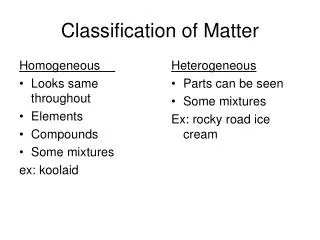
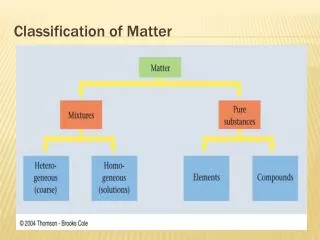
Substances • Can be heterogeneous • Two or more phases Gravel, cookies • Can be homogeneous • Only one phase • Air, water, salt water, a piece of iron
Mixture • More than one Pure Substance physically mixed together
Solution • A mixture that looks like a pure substance. • Particles of all substances are completely mixed together
Solutions: Homogenous Mixtures • A solute is the substance to be dissolved • The solvent is the one doing the dissolving • Universal solvent- generally thought of as water
WHAT IS? • Identify the solvent and solute • 100 mL of water • 0.1 g of sugar
Solid Solutions -Alloys • Made by melting different metals and mixing them together • Examples of Alloys are: • Steel (iron, carbon and other elements like Cr and Mo) • Brass (copper and zinc) • Bronze (copper and tin)
Solid Solutions -Alloys • Amalgams – special type of alloy that combines Mercury with other metals [old dental work] • Titanium alloys (used to make high-end bike parts & frames)
Suspension • Particles are large enough to make it cloudy.
Mechanical Mixture • You can see particles of different substances
Pure Substances • Matter with a unique set of properties • Can be an elementor a compound
Elements • are composed of ATOMS • Atoms of different elements have different masses • is a pure substance that can not be broken down further by chemical means
Element • A Pure Substance made up of • ONE kind of atom • Its symbol can be found on the • Periodic Table
Metals and Non-Metals • An element can either be a metal or a non-metal
Non-Metals • Generally gases or dull, brittle solids at room temperature • Bromine is the only liquid • Conduct heat and electricity poorly
Metals • shiny and solid at room temperature • Exception Mercury [only liquid] • Conduct heat and electricity • Ductile and malleable
Compound • A Pure Substance made up of two or more kinds of atoms.
Law of Definite Proportions
Compounds • Every compound has its own chemical formula • Water is H20
Compound Water Hydrogen Water Oxygen
Compounds • Contain symbols of different elements H2SO4 NaCl C2H5OH C3H8
Compounds • NOTE: The properties of compounds are always different than the properties of their elements!
Ionic Compounds • An Ionic Compound is made up a metal and a non-metal or has Polyatomic Ions in it. • Polyatomic ions are ions made up of more than one kind of atom • They can be found on your ion table (back of Periodic Table) • Some Examples: • SO42- (sulphate), CO32- (carbonate)
Ionic Compounds • Some example of IONIC compounds are: • NaCl • MgBr2 • Al2O3 • K2SO4
Covalent Compounds • A Covalent Compound is made up of a two non-metals or is a hydrocarbon • Some example of COVALENT compounds are: • CO2 , PBr3 , CCl4 , C8H18 , XeF6 , C4H9OH