Understanding Density: Calculation, Concepts, and Practice Problems
This guide covers the fundamental concepts of density, defined as mass per unit volume. It explains the formula for calculating density (D = mass/volume) and provides examples of various substances, including their densities. Key principles include why objects float or sink based on their density compared to the fluid they are in. The guide also includes practice problems to illustrate how to calculate density, mass, and volume for different materials, such as wood, water, copper, and tar. Suitable for students and anyone interested in the science of density.


Understanding Density: Calculation, Concepts, and Practice Problems
E N D
Presentation Transcript
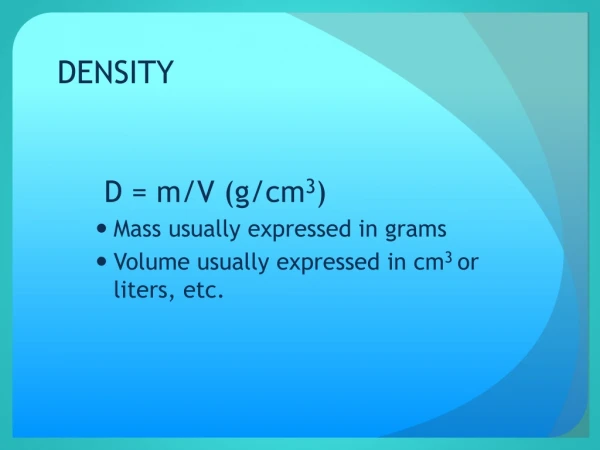
m D v Density • Density – mass per unit volume • Density = mass / volume (g/ml or g/cm3) • The density of water is 1.0 g/ml or 1.0 g/cm3 m = mass (unit – g) D = Density (unit g/ml or g/cm3) v = volume (unit – ml or cm3)
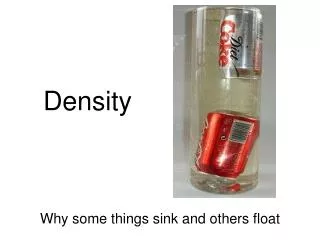
Density • An object that is less dense than the fluid in which it is immersed floats • An object that is denser than the fluid in which it is immersed sinks
Densities of Substances • 0.78 g/cm3 = wood • 0.92 g/cm3 = corn oil • 0.93 g/cm3 = plastic • 1.00 g/cm3 = water • 1.02 g/cm3 = tar • 1.26 g/cm3 = glycerin • 1.34 g/cm3 = rubber • 1.38 g/cm3 = corn syrup • 8.80 g/cm3 = copper • 13.6 g/cm3 = mercury
m D v Practice Problems • A block has a volume of 25 cm3 and a mass of 20 grams. What is the density, and what is the object? • Density = mass / volume • Density = 20 grams / 25 cm3 • Density = 0.8 • Density = 0.8 g/cm3 • Object is wood • 0.78 g/cm3 = wood • 0.92 g/cm3 = corn oil • 1.00 g/cm3 = water • 1.02 g/cm3 = tar
m D v Practice Problems • A piece of copper has a volume of 50 cm3. What is the mass of the piece of copper? • Mass = Density x volume • Density of Copper = 8.80 g/cm3 • Mass = 8.80 g/cm3 x 50 cm3 • Mass = 440 • Mass = 440 g • 1.26 g/cm3 = glycerin • 1.34 g/cm3 = rubber • 1.38 g/cm3 = corn syrup • 8.80 g/cm3 = copper
m D v Practice Problems • A blob of tar has a mass of 30 g – what is the volume of the blob of tar? • Volume = mass / Density • Density of tar = 1.02 g/cm3 • Volume = 30 g / 1.02 g/cm3 • Volume = 30.6 • Volume = 30.6 cm3 • 0.78 g/cm3 = wood • 0.92 g/cm3 = corn oil • 1.00 g/cm3 = water • 1.02 g/cm3 = tar