Chapter 7: Feedbacks
This chapter explores the concepts of positive and negative feedback within the climate system. Positive feedback amplifies changes, as illustrated by an interest-earning savings account where accrued interest accelerates growth. Conversely, negative feedback counters changes, exemplified by the body's cooling mechanism through sweating. The chapter also discusses significant feedback loops, such as the Ice-Albedo Effect and water vapor dynamics, highlighting their roles in stabilizing or amplifying climate variables like temperature. Understanding these mechanisms is crucial for grasping climate change implications.

Chapter 7: Feedbacks
E N D
Presentation Transcript
Chapter 7: Feedbacks GEO 307
Positive feedback - initial change will bring about an additional change in the same direction. Example - growth of an interest-earning savings account. As interest is accrued the principal will begin to grow. As the principal grows, even more interest will be accrued, quickening the rate of principal growth.
Negative feedback - an initial change will bring about an additional change in the opposite direction. Example - body's cooling mechanism, when body Trises, you sweat, evaporation sweat cools body and T returns to normal.
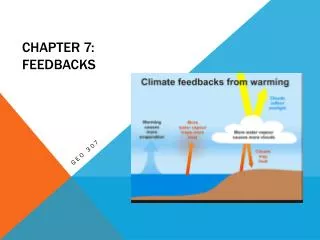
Feedbacks • A loop of cause and effect. • At the center of the feedback is a state variable (avg. T of Earth). • Positive feedback – Makes the T change larger than it would be w/o the feedback. • Negative feedback – counteracts some of the external forcing and stabilized the state (T).
Ice Albedo Feed back SB Feed back SB d SB - Main negative Feedback Negative feedbacks are stabilizers Ice Albedo - Positive Feedback (high lat.) Positive feedbacks are amplifiers 7.1d: Water Vapor Feed back c 7.1c: Hydrologic Cycle Feed back
7.1a: SB Feed back Main Positive feedback Doubles impact of CO2 7.1b: Ice Albedo Feed back d 7.1d: Water Vapor Feed back Controls the amount of water vapor in atm. c 7.1c: Hydrologic Cycle Feed back
Clouds Table 7.1 High clouds – warming Low clouds - cooling
CLouds • The IR effect of clouds 1) warms the Earth 2) depending on the altitude (Temperature) of cloud tops. • High clouds warm, low clouds cool. • See Table 7.1
Other potential feedbacks • Ocean currents • Terrestrial biosphere • Carbon cycle • Paleoclimate record