Understanding Proteins and Nucleic Acids: Structure, Function, and Synthesis
This resource explores the fundamental concepts of proteins and nucleic acids, detailing their compositions, structures, and roles in biological systems. Proteins, made of amino acids linked by peptide bonds, exhibit diverse structures like helixes, pleated sheets, and globular forms, influenced by environmental conditions such as temperature and pH. Nucleic acids, composed of nucleotides, serve essential functions in heredity and protein synthesis. Learn about the building blocks of life and the chemistry behind these vital molecules.

Understanding Proteins and Nucleic Acids: Structure, Function, and Synthesis
E N D
Presentation Transcript
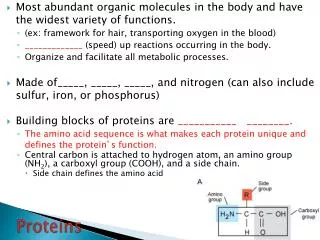
III. Proteins: amino acids composed of ___________, which are made up of C, H, O, N, and S atoms
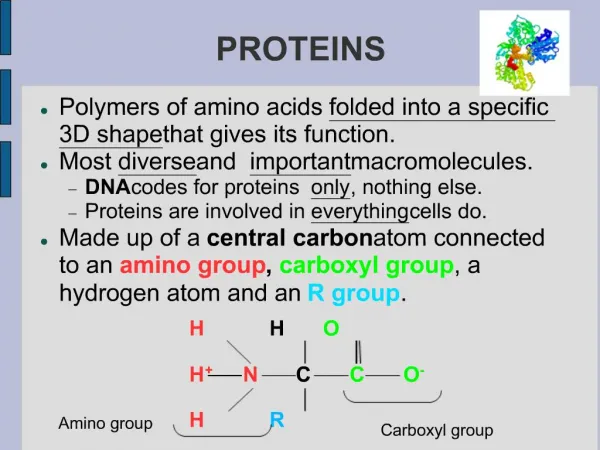
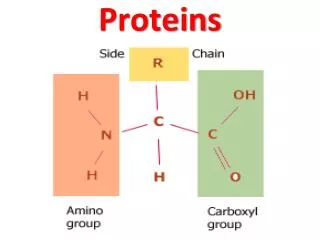
A. Amino acids: 20 1. There are ______ different amino acids that make up most proteins.
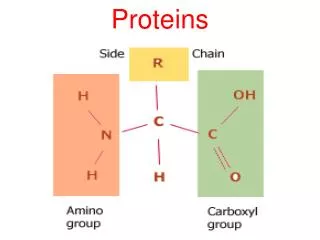
Amino acids are linked through peptide bonds by Dehydration synthesis to form polypeptides
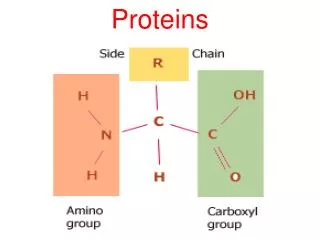
O O H H H H C C OH OH C C N N H H R R Amino acids are linked together to form polypeptides Uses the Same chemical reactions +
Amino acids are linked together to form polypeptides Step 1: remove H and OH O O H H H H C OH + C N C C N H R R H OH
O O H H H H C OH C N C C N H R R Amino acids are linked together to form polypeptides Step 2: Link rest of monomers together H OH
O O H H H H C OH C N C C N H R R Amino acids are linked together to form polypeptides Product: growing chain + 1 water molecule + H OH New bond; Called peptide bond
+ + H2O
Amino acids can be polar, non-polar, charged or uncharged. This affects the of the protein. structure
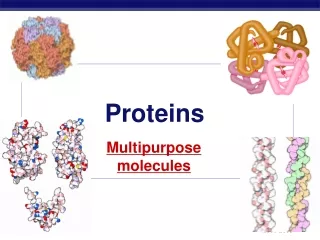
B. Polypeptides: very long chains of amino acids. The amino acids in the chains interact with each other, forming different types of structures: • Helixes or coils
B. Polypeptides: very long chains of amino acids. The amino acids in the chains interact with each other, forming different types of structures: • Helixes or coils • Pleated Sheets
B. Polypeptides: very long chains of amino acids. The amino acids in the chains interact with each other, forming different types of structures: • Helixes or coils • Pleated Sheets • Globular
structure C. The ___________ of a protein is greatly influenced by conditions such as : • Temperature • pH
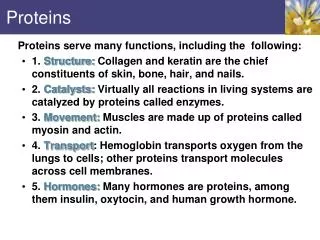
D. Functions: There are many different kinds of proteins each with different roles.
D. Functions structural support • Provide ________________ and ________________. Example: keratin and collagen 2. Control the rate of reactions: enzymes building material chemical
D. Functions • Carry and transport substances in and out of ____. Example: hemoglobin • Fight against _______: antibodies cells disease
IV. Nucleic Acids composed of a chain of ___________________. nucleotides
NUCLEIC ACID • Compounds that contain phosphorus, nitrogen, carbon, hydrogen, and oxygen
a. Names of Nitrogenous Bases • Adenine (A) • Thymine (T) • Cytosine (C) • Guanine (G)
B. DNA (deoxyribonucleic acid) is a double stranded molecule. It stores the hereditary information used to make proteins. a. Nitrogenous bases pair up: • A and T • G and C
C. RNA (ribonucleic acid) is a single stranded molecule, used in making proteins. a. Uses the nitrogenous base, Uracil (U) instead of Thymine
Structure of Nucleic Acids - Build/broken down using same reactions!! H H OH H Base P o CH2 H H P = Phosphate = H2PO3
Base H20 H H H Base o P CH2 H OH H H H o CH2 P H H H OH P = H2PO3 = HPO3-
H H H Base o P CH2 OH H H H H Base o CH2 P H H H
Chain forms by connecting the sugar of one nucelotide to Phosphate of the next. Forms Phosphate-sugar backbone Base o CH2 P H H H H H H Base o P CH2 OH H H H H