Chemical Equilibrium
This material covers the fundamentals of chemical equilibrium and reversible reactions. It explains how products can reform into reactants, characterized by equilibrium expressions and constant ratios. The equilibrium is defined as the state when the rates of forward and reverse reactions are equal, and concentrations remain unchanged. Key concepts include Le Châtelier's Principle, effects of temperature, pressure, and concentration on equilibrium, and the calculation of equilibrium constants (K). Additionally, the document addresses the ionization of weak acids and the creation of buffer solutions.

Chemical Equilibrium
E N D
Presentation Transcript
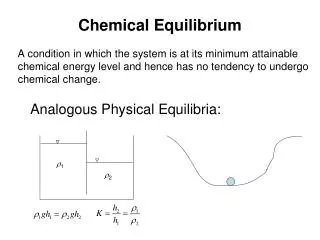
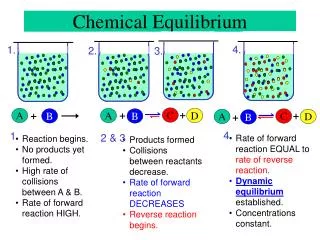
Reversible Reactions Freezing Ice? Cooking an egg? Melting water? • Reversible reactions are those in which the products can react to re-form reactants. • Ex: 2HgO (s) + heat -------------> 2Hg (l) + O2 (g) 2Hg (l) + O2 (g) -------------> 2HgO (s) + heat • Chemical Equilibrium: When the rate of the forward reaction = the rate of the reverse reaction AND the concentrations of product and reactants remain the same.
Equilibrium • If product is favored, the reaction is represented as: HBr (aq) + H2O(l) H3O+ (aq) + Br- (aq) • If reactant is favored, the reaction is represented as: H2CO3 (aq) + H2O (l) H3O+ (aq) + HCO3- (aq) • If concentrations of reactants = products: H2SO3 (aq) + H2O (l) H3O+ (aq) + HSO3- (aq) • The extent to which reactants ----> product is determined from the equilibrium constant. --------> <--- ---> <------ -------> <-------
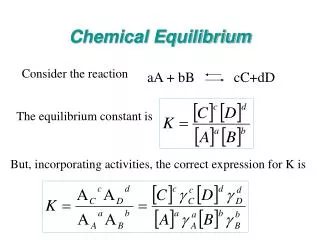
The Equilibrium Expression • Since the concentrations of reactants and products after equilibrium has been established remain constant, so does the ratio of reactant to product. Ex: nA(aq)+ mB(aq) -------> xC(aq) + yD(aq) • K = [C]x[D]y K is determined experimentally K is dependent on temperature No solids or liquid included in the equilibrium expression [A]n[B]m If K > 1, product is favored If K < 1, reactant is favored If K = 1, reactant = product
Question • What is the equilibrium expression for the following reaction at equilibrium? • H2(g) + I2 (g) HI (g) • K = [HI]2 • The equilibrium expression can be used to calculate concentrations of reactants and products at equilibrium. Let’s try… ------> <------ [H2][I2]
Predicting Direction of a Shift in Equilbrium • Le Chatelier’s Principle: If a stress is applied to a system at equilbrium, the system will react in a way to minimize that stress. • Changes in pressure: • Affect gases only! • Changes in temperature • Changes in concentration: • Solids and liquids not affected. - K is not affected.
Reactions that Go to Completion • In these reactions, ions are almost completely removed from solution. • Formation of a gas • Ex: H2CO3 (aq) H20 (l) + CO2 (g) • Formation of a precipitate • Ex: NaCl(aq) + AgNO3(aq) NaNO3 + AgCl (s) • Formation of a slightly ionized product (acids and bases) Ex: HCl(aq) + NaOH(aq) NaCl(s) + H2O(l)
Common Ion Effect • When the addition of an ion common to 2 solutes brings about precipitation. • Ex: NaCl (s) Na+ (aq) + Cl- (aq) • If I now add HCl to this solution, which ion will be affected? • HCl(g) + H2O(l) -----> H3O+(aq) + Cl-(aq) • Equilibrium will shift to the left (production of Solid NaCl) --------> <--------
Equilibria of Acids, Bases and Salts • Ionization of a Weak Acid CH3COOH + H2O H3O+ + CH3COO- • K = [H3O+ ][CH3COO-]/[CH3COOH][H2O] • We can assume that the [H2O] remains constant. • K[H2O] = [H3O+ ][CH3COO-] = Ka -------> <------- Acid Ionization Constant [CH3COOH]
Ka • Constant at a given temperature. • For weak acids, Ka is < 1. • To determine the Ka, the [ ] of involved reactants/products must be known. • [ ] are found by measuring pH. • Kb used for bases.
Buffers Resist changes in pH • Weak acid + its salt (or weak base + salt) • Salts of a weak acid can combine with the extra H3O+ that is produced. • Ex: CH3COOH/NaCH3COO solution • CH3COO-+ H3O+ ----> CH3COOH + H2O Buffered Solution Acid No pH change • CH3COO- + H+ + OH- H20 first Buffered Solution Base • CH3COOH + H20 CH3COO-+H3O+ second Offsets original base
Hydrolysis of Salts • Salts formed during neutralization • Hydrolysis occurs when water molecules combine with ions of a dissolved salt. • Can form acidic, basic or neutral solutions: • Strong Acid + Strong Base -----> Neutral • Strong Acid + Weak Base -----> Acidic • Strong Base + Weak Acid -----> Basic • Weak Base + Weak Acid ------> Unpredictable
Solubility Equilibrium • Used to predict whether precipitation occurs when solutions are combined. • Soluble (>1 g/100 g water) • Ex: AgCl (s) -----> Ag+ (aq) + Cl-(aq) • Ksp = [Ag+][Cl-] = Solubility Product Constant • If Ksp>ion product, the substance DISSOLVES (unsaturated- no solid present) • If Ksp<ion product, there is PRECIPITATION • Pg. 579 Table 18-3