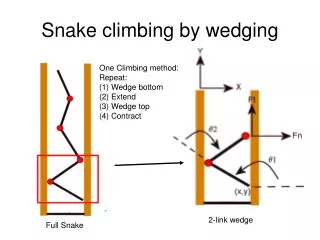
Dynamics of Snake Climbing Using a Two-Link Wedge Mechanism
40 likes | 179 Vues
This document explores the mechanics of a snake's climbing method using a two-link wedge system. The climbing technique involves a sequence of steps: wedging at the bottom, extending, wedging at the top, and then contracting the two-link wedge while maintaining zero velocity. The dynamics are analyzed using Lagrange's equations of motion and contact-coordinate relations, particularly focusing on friction cone complementarity conditions. The goal is to ensure the wedge remains stationary while climbing, achieved through enumerating feasible contact modes and validating solutions with constraints.


Dynamics of Snake Climbing Using a Two-Link Wedge Mechanism
E N D
Presentation Transcript
Snake climbing by wedging One Climbing method: Repeat: (1) Wedge bottom (2) Extend (3) Wedge top (4) Contract 2-link wedge Full Snake
Dynamics of 2-link Wedge (at zero velocity) Lagrange EOM Contact-Coordinate Relation Friction Cone Complementarity Conditions Goal: The 2-link wedge should remain stationary while climbing Step 1: Enumerate feasible contact modes Step 2: Solve equations using contact mode assumptions Step 3: Check consistency of solutions with assumptions and constraints.
t C.O.M. Position Solutions of 2-link Wedge Dynamics Mode Stick-Stick-Stick Eqn: Soln: Consistency: Solutions functions of joint torque, c.o.m. location Choose joint torque so Stick-Stick-Stick only possibility for the entire range of c.o.m locations Good torque choice Stick-Stick-Stick Mode