The Enlightenment: Shaping Modern Thought and Society
This lesson explores the pivotal changes in thought during the Enlightenment and the 18th century. Students will understand how Enlightenment thinkers challenged traditional authority, including the divine rights of kings and church dogma, promoting human agency and knowledge. By comparing Enlightenment ideals with revolutionary movements, students will learn about key contributors to this era, including their views on government, economics, and society. Assessments will include quizzes and essay questions, encouraging critical thought on how these ideas influenced modern political frameworks.

The Enlightenment: Shaping Modern Thought and Society
E N D
Presentation Transcript
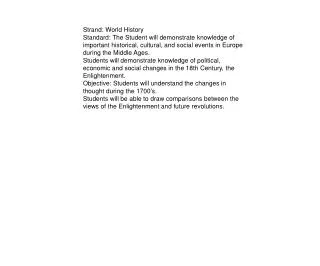
Strand: World History Standard: The Student will demonstrate knowledge of important historical, cultural, and social events in Europe during the Middle Ages. Students will demonstrate knowledge of political, economic and social changes in the 18th Century, the Enlightenment. Objective: Students will understand the changes in thought during the 1700's. Students will be able to draw comparisons between the views of the Enlightenment and future revolutions.
The Enlightenment was the celebration of human - In it, it culminated the departure from the divine rights of king and church dogma, while celebrating the capacity of humans to kno and change the world In it new thoughts in - were founded and ushered in a whole new era of government, economics,
The Enlightenment was the celebration of human - Characteristics of the Enlightenment In it, it culminated the departure from the divine rights of king and church dogma, while celebrating the capacity of humans to kno and change the world In it new thoughts in - were founded and ushered in a whole new era of government, economics,
Which of these people are associated with the Enlightenment? Sorry Try again! US President. Correct! Notion of separation of powers Correct! New respect for the common man, nobility and wisdom can come from anywhere Wrote "Wealth of Nations" 1776
Roll the dice and give a brief description of the person listed
Objective: Students will understand the changes in thought during the 1700's. Students will be able to draw comparisons between the views of the Enlightenment and future revolutions. Student assessment would be a quiz on what was learned, with a short essay question.
Attachments Characteristics of the Enlightenment.isf Enlightenment Thinkers and contributions.isf Spreading of Enlightened ideals.isf American RevolutionFoundation.isf