Comparing Randomization Methods in Clinical Trials and Statistical Analysis of Hormone Levels
In this exercise, we explore different randomization techniques for a clinical study with 10 patients, comparing standard treatment to a new treatment. We discuss the pros and cons of simple randomization versus blocked randomization, emphasizing the importance of fair patient allocation. Furthermore, we analyze testosterone levels using ANOVA and lme methods, ensuring that results remain consistent across approaches. The study utilizes statistical data from various sources, including Rosner's endocrinology dataset and the MASS library.

Comparing Randomization Methods in Clinical Trials and Statistical Analysis of Hormone Levels
E N D
Presentation Transcript
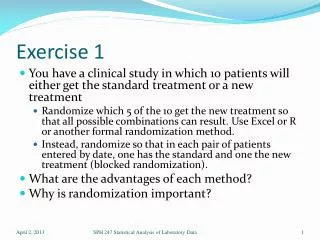
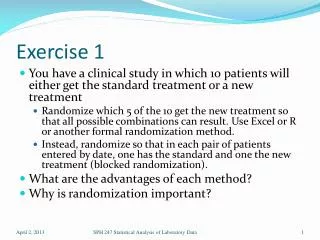
Exercise 1 • You have a clinical study in which 10 patients will either get the standard treatment or a new treatment • Randomize which 5 of the 10 get the new treatment so that all possible combinations can result. Use Excel or R or another formal randomization method. • Instead, randomize so that in each pair of patients entered by date, one has the standard and one the new treatment (blocked randomization). • What are the advantages of each method? • Why is randomization important? SPH 247 Statistical Analysis of Laboratory Data
Exercise 2 • Analyze the testosterone levels from Rosner’sendocrin data set in the same way as we did for the estradiol levels, using anova(lm()) • Reanalyze estradiol and testosterone using lme() and verify that the results are the same. Here is the specificationlme(Testosterone ~ 1, random = ~1 | Subject,data=endocrin) • Repeat the analysis of the coop data for specimens 2 and 5 separately. Do the analysis both with the traditional ANOVA tables using lm() and with lme() and compare the results SPH 247 Statistical Analysis of Laboratory Data
Data Sources • The coop data is from the MASS library (Modern Applied Statistics in S) • The folate data and the enalaprilat data are from ISwR (Introductory Statistics with R) • Estradiol data are from Rosner • Fasting blood glucose from Andrews and Herzberg, Data, with the data on Statlib athttp://lib.stat.cmu.edu/datasets/Andrews/ SPH 247 Statistical Analysis of Laboratory Data
Course Website • http://dmrocke.ucdavis.edu SPH 247 Statistical Analysis of Laboratory Data