Constant & Changing Motion
This guide provides a comprehensive overview of critical concepts in motion, including reference points, distance, displacement, speed, and velocity. You will learn how to calculate total distance traveled and how to determine net displacement between two points. The guide also explains average velocity, instantaneous velocity, and the fundamental distinction between speed (a scalar quantity) and velocity (a vector quantity). Additionally, it covers acceleration and introduces the four basic equations of motion under constant acceleration, essential for mastering one-dimensional motion analysis in physics.

Constant & Changing Motion
E N D
Presentation Transcript
Reference Point A fixed point from which direction is defined. The reference point can be anything.
Distance The length traveled measured from start to finish. Use meters!!!
Example #1 A car drives 4 meters north, 3 meters south, then 5 meters north. What’s its total distance driven? D = 4m + 3m + 5m D = 12m
Direction Represented by using : (+) or (-) signs Up or Down Right or Left Forward or Backward North, South , East or West
Position Where something is, relative to the reference point.
Displacement The net difference between the starting point and the ending point. Dd = dfinal – dinitial
Example #2 A car drives 4 meters north, 3 meters south then 5 meters north. What’s its displacement? Δd = 9m north – 3m south Δd = 6m north These are the vectors that we’ve been practicing!
Time Interval The difference between two clock readings t = tfinal – tinitial Use seconds!!!
Speed Total distance traveled divided by the total time elapsed. speed = distance/time
Average Velocity ( Vavg) Total distance traveled divided by the total time elapsed. Vavg = Dd/Dt Units: m/s Magnitude (size) and direction
Δt includes ALL time, whether you were moving or not! Average Velocity 1 second 2 minutes 3 seconds 1 mile 2 miles 2 miles home Dairy Queen 4 hr. EXXON 3 hr. LHS 5 miles Δt = 1 sec + 14400 sec + 120 sec + 10800 sec + 3 sec Δt = 25324 sec (x 1 hr / 3600 sec = 7.03 hr) Vavg = 5 mi / 7.03 hr Vavg = 0.71 mi/hr
What is the difference between speed and velocity? • Velocity is a vector quantity (magnitude & direction) • Speed represents the magnitude of velocity (scalar quantity)
Instantaneous Velocity (V) • Velocity at onepoint • Δd and Δt are very, very, very, very……small!
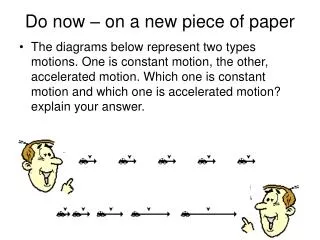
Constant Velocity • If a body is moving at a constant velocity, the velocity never changes between intervals. • Doesn’t happen often in real life! • Ex: V = 10 m/s V = 10 m/s V = 10 m/s
Changing Velocity • Here, the velocity changes between intervals. • Ex: V = 10 m/s V = 15 m/s V = 20 m/s
Acceleration • Acceleration is the change in velocity over time. • Average acceleration (aavg ) = change in velocity time spent • aavg = ΔV / Δt • Units: (m/s) m s s2
Acceleration Example #1 Δt = 2 sec • Find aavg. Vi = 10 m/s Vf = 40 m/s aavg = 40 – 10 m/s 2 s aavg = 15 m/s2 *This means that the object’s velocity increases 15m/s every second!
Acceleration Example #2 Δt = 2 sec • Find aavg. Vi = 40 m/s Vf = 10 m/s aavg = 10 – 40 m/s 2 s aavg = -15 m/s2 *This means that the object’s velocity decreases 15m/s every second!
Acceleration Example #3 Δt = 2 sec • Find aavg. Vi = 40 m/s Vf = 40 m/s aavg = 40 – 40 m/s 2 s aavg = 0 m/s2 *This means that the object’s velocity is constant!
Four Basic Equations of Physics • Conditions: • One-dimensional motion • Constant acceleration
Four Basic Equations of Physics • Vf = Vi + at • d = Vi t + ½ at2 • 2ad = Vf2 – Vi2 • Vf + Vi 2 d = t