Understanding the Classification of Matter: Chemical vs. Physical Properties
This guide explores the classification of matter, differentiating between chemical and physical properties. Physical properties are observable traits that do not change the substance, such as size, shape, and density. In contrast, chemical properties describe a substance's ability to transform into a different substance, evident in processes like oxidation and combustion. Additionally, we define intensive properties, which remain constant regardless of matter quantity, against extensive properties, which depend on the amount present. Understanding elements, compounds, and the periodic table is also covered.

Understanding the Classification of Matter: Chemical vs. Physical Properties
E N D
Presentation Transcript
Chemical vs. Physical • Physical Properties: Properties you can observe without changing the substance. • ex: size, shape, density, odor • Chemical Properties: A substances ability to undergo a transformation to a different substance. • ex: oxidize (rust), combustibility, reacts with acid
Intensive vs. Extensive • Extensive Property: Depends on the amount of matter present. • ex: mass, volume • Intensive Property: Does not depend on the amount of matter present. • ex: color, density
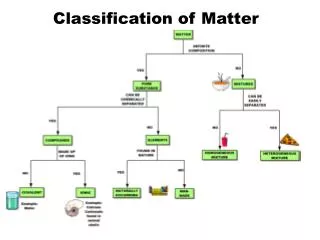
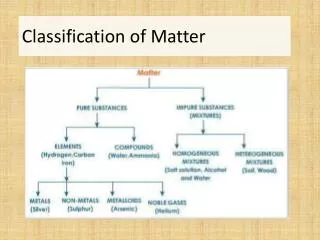
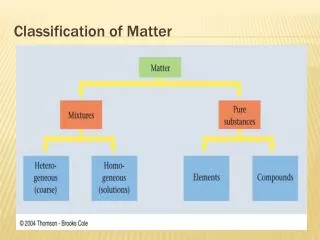
Classification of Matter Matter Can it be separated? Yes No Mixture Pure Substance Can it be broken down by normal chemical means? Is the composition uniform? No Yes Yes No Homogeneous Mixture Heterogeneous Mixture Compound Element
The Periodic Table of Elements Groups: Columns going down Periods: Rows going across
Types of Elements • Metals
Types of Elements • Properties of Metals • Good Conductor • Malleable • Ductile • Luster
Types of Elements • Nonmetals
Types of Elements • Properties of Nonmetals • Poor Conductor • Brittle when solid
Types of Elements • Metalloids – mix of metal and nonmetal properties. Most are semiconductors.