Comprehensive Ladder Safety Guide for Wildlife Services Workers
This guide explores ladder safety for wildlife and other service workers, discussing OSHA standards, ladder requirements, inspection tips, and fall prevention techniques. It covers proper ladder selection, maintenance, and use to prevent accidents and ensure worker safety in the field. Learn about stabilizing ladders, using fall arrest systems, and essential equipment for working at heights. Stay informed and equipped for safe ladder practices in various work environments.

Comprehensive Ladder Safety Guide for Wildlife Services Workers
E N D
Presentation Transcript
Objectives: • Help you decide if you really want to get into the business of wildlife and other services that require ladder use. • Create awareness of what actually happens in the field when you are not looking. • Show you examples of the crazy things employees will do when you are not looking
OSHA: • OSHA 29 CFR 1926.500 • Have you ever asked 5 people the same question regarding an OSHA standard? • What do you get? • 10 different answers • Although this presentation is designed to help you understand, you need to read the rules.
Ladder Requirements • Maximum length • Single ladders - 30 feet long • Extension ladders - 60 foot long • Portable step ladders - 20 feet long • Shall be equipped with metal spreader or locking device • All ladders should be maintained in good condition at all times
Choose the right ladder! • The ladder you choose should be tall enough allow you to work at the desired height without standing on the top rung or step of the ladder.
Inspect your ladders! • When: Prior to each use • What to look for: • Extension Ladders- • Ropes • Missing • Frayed • Not connected properly • Structure • Bent Rails • Damaged Rungs • Loose rungs (can be moved by hand)
Inspect Your Ladders! • Damaged feet • Damaged extension locks • Don’t seat properly • Missing • Loose or broken • Step Ladders- • Wobbles from side to side • Loose or bent hinge spreaders • Broken stop on hinge spreaders • Loose Hinges
Prevent a Fall – Ladders • Placed with secure footing, or shall be latched or held in position YES!
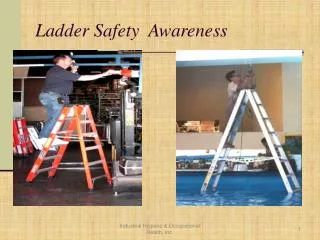
Prevent a Fall – Ladders Placed with secure footing, or shall be latched or held in position NO!
Prevent a Fall- Ladders • 3 Point Contact • One hand secure and two feet secure • Two hands secure and one foot secure
Prevent a Fall – Ladders • Always face forward and utilize the three point contact rule. YES!
Prevent a Fall – Ladders • Always face forward and utilize the three point contact rule. NO!
Prevent a Fall – Ladders • Maintain four (4) to one (1) ratio when setting up an extension ladder. • Example: • The gutter is 28 feet from the ground • 28 ÷ 4 = 7 • The bottom of the ladder should be 7 feet out from the point the ladder touches the house
Prevent a Fall – Ladders 28’ 7’
Prevent a Fall – Ladders • When reaching out from a ladder, keep your belt buckle or the midpoint of your body between the rails to prevent overreaching. YES!
Prevent a Fall – Ladders • When reaching out from a ladder, keep your belt buckle or the midpoint of your body between the rails to prevent overreaching. NO!
Prevent a Fall- Ladders • Stabilize the top so that the ladder does not shift from side to side. Ladder Stabilizer
Securing ladders to vehicles • Use heavy duty ratchet straps • Use bicycle cable lock to secure • Bolt the ladder to the ladder rack • Walk around the vehicle and check the ladders prior to departing the location.
Ladder accessories Yes ladies; you can even accessorize a ladder!
Why spend $139 on adjustable feet? To prevent this
Fall Arrest Systems - Basics • Do not need fall arrest system if person is staying on extension ladder • Belt buckle must stay inside side rails of ladder • Need fall arrest system if they leave the ladder to go to another level • Must wear a body harness • Must use a lanyard • Must have an anchor point rated to 5,000#s
Fall Arrest Systems- Equipment Ascenders allow person to move upwards with the security of quick catch if they fall.
Fall Arrest Systems- Equipment Full body harness allows for the shock of the fall to be distributed evenly over the body not just the waist.
Fall Arrest System- Equipment Lanyards connect between the body harness and the ascender to allow freedom of movement. Some are shock absorbing.
Fall Arrest System- Equipment Ropes are used as lifelines. Do not buy cheap ropes.
Fall Arrest- Anchor points • Trees • Fence posts that are concreted in • Vehicles • Mobile home anchors.
Anchoring Methods • Over the roof • Horizontal Life Line on ground