Notes: Probability
This guide explores the concept of probability, defining it as the likelihood of an event occurring and often expressed as a fraction. It features practical examples, such as determining the probability of rolling an even number on a die, spinning a spinner, or rolling two dice with specific outcomes. Each scenario presents a clear question for understanding winning chances and calculating probabilities. Engage with this informative content to sharpen your skills in probability, ideal for beginners and those looking to reinforce their knowledge through real-life games and situations.

Notes: Probability
E N D
Presentation Transcript
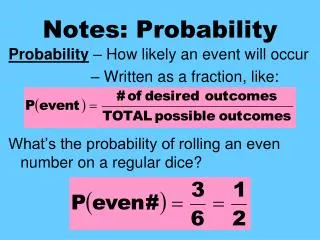
Notes: Probability Probability – How likely an event will occur – Written as a fraction, like: What’s the probability of rolling an even number on a regular dice?
Examples: Probability What is the probability of rolling a number less than three on a number cube (dice)? 1
Examples: Probability A game requires spinning the spinner shown below. If the number spun is greater than 3, the player wins. What is the probability of winning the game? 2
Examples: Probability A game requires spinning the spinner shown. If the number spun is greater than 3, the player wins. What is the probability of not winning? 3
Examples: Probability A game requires rolling two dice. If the sum of the two rolls is five or less, you win. What is the probability of winning the game? 4 Make a chart or list!
Examples: Probability In the Dallas Wind Symphony, there are 5 French Horns, 3 Trombones, 6 Trumpets, and 2 Tubas. If one player is chosen at random, what is the probability of: 5 6 7