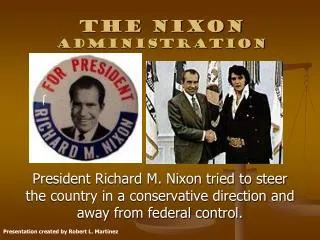
The Nixon Administration
110 likes | 230 Vues
This article explores the political and domestic strategies employed by Richard Nixon during his presidency. It focuses on the Southern Strategy aimed at gaining support in the South, his New Federalism policies that shifted power to state and local governments, and the Family Assistance Plan designed to aid poor families. Additionally, it highlights Nixon's foreign policy initiatives, including his relationship with China and the USSR, the concept of détente, and the strategic arms limitation efforts that marked significant steps towards easing Cold War tensions.


The Nixon Administration
E N D
Presentation Transcript
The Southern Strategyhttp://suite101.com/article/the-southern-strategy-and-richard-nixon-a269466 • Used by Nixon in order to gain support of more southern states for the Republican party. • Did so by appointing conservatives to federal courts • Also by choosing a VP candidate that was acceptable to the south
A Law-and-Order President • Nixon targeted antiwar protestors and replaced many liberal officials
The New Federalismhttp://www.businessdictionary.com/definition/New-Federalism.html • These were Nixon’s domestic policies • Got rid of many federal programs and gave more control to state and local governments
The New Federalism • Under this program, Congress passed revenue sharingbills • Grants federal money to state and local agencies • This inadvertently gave the federal government more power • They could put conditions on the states that, if not met, would cause funds to be cut.
The New Federalism • Nixon also impounded funds if Congress set aside money for programs he opposed
The Family Assistance Planhttp://www.pbs.org/wgbh/americanexperience/features/general-article/nixon-domestic/ • Proposed by Nixon in hopes of providing for the poor while promoting jobs for those on welfare • It gave needy families $1,600 per year • The House of Rep. approved the plan in 1970, but it failed in the Senate
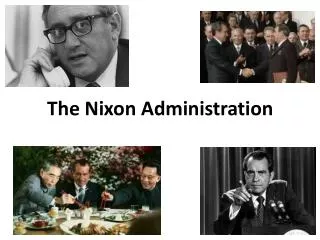
Nixon’s Foreign Policy • Nixon appointed Henry Kissinger as his national security advisor • Helped shape his foreign policy • both believed in a gradual withdrawal from Vietnam
Nixon’s Foreign Policy • Both saw the policy against communism as too rigid to actually benefit the US • As a result they began strengthening relations with China and USSR • Aka: détente • The USSR was skeptical
Nixon Visits China • In 1972, Nixon went to China and the leaders of both nations agreed to set up more normal relations • Nixon hoped this would encourage the USSR to do the same
US-Soviet Tensions Ease • Shortly after, the Soviets proposed a summit • High-level diplomatic meeting • Here the two countries signed the first Strategic Arms Limitation Treaty (SALT I) • A plan to limit nuclear arms • also agreed to increase trade and exchange scientific info