Nixon's Administration: Restoring Order and Navigating Cold War Diplomacy
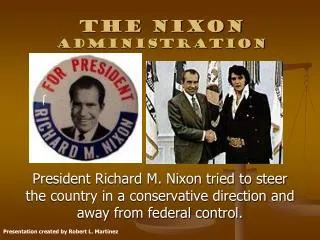
During his presidency, Richard Nixon aimed to restore law and order while navigating Cold War tensions. His appeal to "Middle America" focused on conservative values and promises of peace, particularly regarding the Vietnam War. Nixon implemented the "Southern Strategy" to gain support from Southern whites and appointed conservative judges to the Supreme Court. Internationally, he fostered détente with the USSR and China, culminating in historic visits and strategic agreements, including the first Strategic Arms Limitation Treaty (SALT I), aimed at reducing nuclear arms.

Nixon's Administration: Restoring Order and Navigating Cold War Diplomacy
E N D
Presentation Transcript
The Nixon Administration Ch. 32, Sec. 1
Key Idea • Pres. Nixon sought to • restore law and order and traditional values at home • ease Cold War tensions abroad.
Appealing to Middle America • Many Americans supported govt. & wanted end to violence of 1960s • 1968 Rep. pres. candidate Nixon appealed to “Middle America” • He promised • peace in Vietnam • law and order • streamlined govt. • return to conservative values
Appealing to Middle America • Nixon’s success in election came from South and he promised to • appoint conservatives to Federal courts • name Southerner to Supreme Court • oppose court-ordered busing • choose VP acceptable to South • Many white Southerners left Dem. Party to vote for Nixon
Appealing to Middle America • After election Nixon began the “Southern strategy” to win more Southerners for Rep. Party • took steps to slow desegregation • set out to battle crime • criticized Supreme Court regarding expanded rights for accused criminals. • appointed several conservative judges to Supreme Court – 1 from South
Appealing to Middle America • Nixon’s dismantled many Federal programs • Control to state & local govts. • Under Nixon’s New Federalism program Congress passed revenue-sharing bills • provided fed. funds to state & local agencies • led to a greater dependency on fed. funds
Appealing to Middle America • 1969 - Nixon proposed replacing existing Aid to Families with Dependent Children (AFDC) welfare program with Family Assistance Plan • give needy families guaranteed yearly grant of $1,600 • won House approval but later defeated in Senate
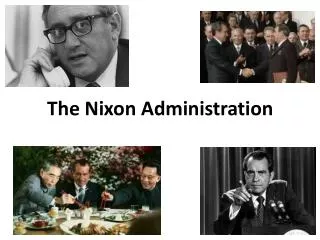
Nixon’s Foreign Policy • Nixon’s administration focused mainly on foreign affairs • chose former Harvard professor Henry Kissinger as national security adviser • attempted friendlier relations w/ Soviet Union & China
Nixon’s Foreign Policy • Nixon was anti-Communist but came to reject idea of bipolar world w/ US & USSR confronting each other • created the approach of détente- relaxation of tensions between US and 2 major Communist rivals–the USSR & China
Nixon’s Foreign Policy • Nixon argued US had to build better relationship w/ rivals to ensure world peace • lifted trade and travel restrictions w/ China & withdrew Seventh Fleet from defending Taiwan • February 1972 - Nixon took historic trip to China, where both leaders agreed to better relations between the nations.
Nixon’s Foreign Policy • May 1972 - Soviets suggested American-Soviet summit • Nixon became 1st pres. to visit USSR • 1stStrategic Arms Limitation Treaty (SALT I) signed to limit nuclear arms • agreed to increase trade & exchange scientific information