Efficient Query Execution Strategies in Database Systems
This recap outlines key topics discussed in the CIS 550 class on Database and Information Systems. It covers various data layout formats, including heap, sorted, and hashed files, and the importance of indexing (both clustered and unclustered) for improved access speeds. The document further explores query execution strategies, the role of the optimizer, and different relational algebra operators. Key aspects include execution plans, resource management, and alternative methods such as pipelining and materialization for efficient query processing.

Efficient Query Execution Strategies in Database Systems
E N D
Presentation Transcript
Query Execution Zachary G. Ives University of Pennsylvania CIS 550 – Database & Information Systems November 23, 2004
Recap of Recent Discussions • We can choose different data layout formats for our tuples: • Heap files • Sorted files • Hashed files • In addition, we can duplicate a certain amount of data in order to speed up access – an index over a search key • Clustered index has data in same order (typically embedded) • Unclustered index has data in some other order • We saw the B+ tree, a balanced search tree with high fan-out
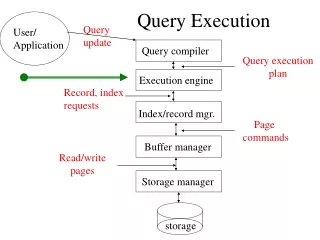
Making Use of the Data + Indices:Query Execution • Query plans & exec strategies • Basic principles • Standard relational operators • Querying XML
Query Plans • Data-flow graph of relational algebra operators • Typically: determined by optimizer JoinPressRel.Symbol = EastCoast.CoSymbol JoinPressRel.Symbol = Clients.Symbol ProjectCoSymbol SelectClient = “Atkins” SELECT * FROM PressRel p, Clients C WHERE p.Symbol = c.Symbol AND c.Client = ‘Atkins’ AND c.Symbol IN (SELECT CoSymbol FROM EastCoast) Scan PressRel ScanEastCoast Scan Clients
Iterator-Based Query Execution • Execution begins at root • open, next, close • Propagate calls to children May call multiple child nexts • Efficient scheduling & resource usage Can you think of alternatives and their benefits? JoinPressRel.Symbol = EastCoast.CoSymbol JoinPressRel.Symbol = Clients.Symbol ProjectCoSymbol SelectClient = “Atkins” Scan PressRel Scan Clients ScanEastCoast
Execution Strategy Issues Granularity & parallelism: • Pipelining vs. blocking • Materialization JoinPressRel.Symbol = EastCoast.CoSymbol JoinPressRel.Symbol = Clients.Symbol ProjectCoSymbol SelectClient = “Atkins” Scan PressRel ScanEastCoast Scan Clients
Basic Principles • Many DB operations require reading tuples, tuple vs. previous tuples, or tuples vs. tuples in another table • Techniques generally used: • Iteration: for/while loop comparing with all tuples on disk • Index: if comparison of attribute that’s indexed, look up matches in index & return those • Sort/merge: iteration against presorted data (interesting orders) • Hash: build hash table of the tuple list, probe the hash table • Must be able to support larger-than-memory data
Basic Operators • One-pass operators: • Scan • Select • Project • Multi-pass operators: • Join • Various implementations • Handling of larger-than-memory sources • Semi-join • Aggregation, union, etc.
1-Pass Operators: Scanning a Table • Sequential scan: read through blocks of table • Index scan: retrieve tuples in index order • May require 1 seek per tuple! When? • Cost in page reads – b(T) blocks, r(T) tuples • b(T) pages for sequential scan • Up to r(T) for index scan if unclustered index • Requires memory for one block
1-Pass Operators: Select (s) • Typically done while scanning a file • If unsorted & no index, check against predicate: Read tuple While tuple doesn’t meet predicate Read tuple Return tuple • Sorted data: can stop after particular value encountered • Indexed data: apply predicate to index, if possible • If predicate is: • conjunction: may use indexes and/or scanning loop above (may need to sort/hash to compute intersection) • disjunction: may use union of index results, or scanning loop
1-Pass Operators: Project (P) • Simple scanning method often used if no index: Read tuple While tuple exists Output specified attributes Read tuple • Duplicate removal may be necessary • Partition output into separate files by bucket, do duplicate removal on those • If have many duplicates, sorting may be better • If attributes belong to an index, don’t need to retrieve tuples!
Multi-pass Operators: Join (⋈) – Nested-Loops Join • Requires two nested loops: For each tuple in outer relationFor each tuple in inner, compareIf match on join attribute, output • Results have order of outer relation • Can do over indices • Very simple to implement, supports any joins predicates • Supports any join predicates • Cost: # comparisons = t(R) t(S) # disk accesses = b(R) + t(R) b(S) Join outer inner
Block Nested-Loops Join • Join a page (block) at a time from each table: For each page in outer relationFor each page in inner, join both pages If match on join attribute, output • More efficient than previous approach: • Cost: # comparisons still = t(R) t(S) # disk accesses = b(R) + b(R) * b(S)
Index Nested-Loops Join For each tuple in outer relationFor each match in inner’s index Retrieve inner tuple + output joined tuple • Cost: b(R) + t(R) * cost of matching in S • For each R tuple, costs of probing index are about: • 1.2 for hash index, 2-4 for B+-tree and: • Clustered index: 1 I/O on average • Unclustered index: Up to 1 I/O per S tuple
Two-Pass Algorithms Sort-based Need to do a multiway sort first (or have an index) Approximately linear in practice, 2 b(T) for table T Hash-based Store one relation in a hash table
(Sort-)Merge Join • Requires data sorted by join attributes Merge and join sorted files, reading sequentially a block at a time • Maintain two file pointers • While tuple at R < tuple at S, advance R (and vice versa) • While tuples match, output all possible pairings • Preserves sorted order of “outer” relation • Very efficient for presorted data • Can be “hybridized” with NL Join for range joins • May require a sort before (adds cost + delay) • Cost: b(R) + b(S) plus sort costs, if necessaryIn practice, approximately linear, 3 (b(R) + b(S))
Hash-Based Joins • Allows partial pipelining of operations with equality comparisons • Sort-based operations block, but allow range and inequality comparisons • Hash joins usually done with static number of hash buckets • Generally have fairly long chains at each bucket • What happens when memory is too small?
Hash Join Read entire inner relation into hash table (join attributes as key) For each tuple from outer, look up in hash table & join • Very efficient, very good for databases • Not fully pipelined • Supports equijoins only • Delay-sensitive
Running out of Memory • Prevention: First partition the data by value into memory-sized groups Partition both relations in the same way, write to files Recursively join the partitions • Resolution: Similar, but do when hash tables full Split hash table into files along bucket boundaries Partition remaining data in same way Recursively join partitions with diff. hash fn! • Hybrid hash join: flush “lazily” a few buckets at a time • Cost: <= 3 * (b(R) + b(S))
Pipelined Hash Join Useful for Joining Web Sources • Two hash tables • As a tuple comes in, add to the appropriate side & join with opposite table • Fully pipelined, adaptive to source data rates • Can handle overflow as with hash join • Needs more memory
Aggregation () • Need to store entire table, coalesce groups with matching GROUP BY attributes • Compute aggregate function over group: • If groups are sorted or indexed, can iterate: • Read tuples while attributes match, compute aggregate • At end of each group, output result • Hash approach: • Group together in hash table (leave space for agg values!) • Compute aggregates incrementally or at end • At end, return answers • Cost: b(t) pages. How much memory?
Other Operators • Duplicate removal very similar to grouping • All attributes must match • No aggregate • Union, difference, intersection: • Read table R, build hash/search tree • Read table S, add/discard tuples as required • Cost: b(R) + b(S)
SQL Operations In a whirlwind, you’ve seen most of relational operators: • Select, Project, Join • Group/aggregate • Union, Difference, Intersection • Others are used sometimes: • Various methods of “for all,” “not exists,” etc • Recursive queries/fixpoint operator • etc.
What about XQuery? • Major difference: bind variables to subtrees; treat each set of bindings as a tuple • Select, project, join, etc. on tuples of bindings • Plus we need some new operators: • XML construction: • Create element (add tags around data) • Add attribute(s) to element (similar to join) • Nest element under other element (similar to join) • Path expression evaluation – create the binding tuples
Match paths: $s = (root)/db/store $m = $s/manager/data() $c = $s//city/data() Standard Method: XML Query Processing in Action Parse XML: <db> <store> <manager>Griffith</manager> <manager>Sims</manager> <location> <address>12 Pike Pl.</address> <city>Seattle</city> </location> </store>… $s $m $c #1 Griffith Seattle #1 Sims Seattle #2 Jones Madison
X-Scan: “Scan” for Streaming XML, Based on SAX • We often re-read XML from net on every query Data integration, data exchange, reading from Web • Could use an XML DBMS, which looks like an RDBMS except for some small extensions • But cannot amortize storage costs for network data • X-scan works on streaming XML data • Read & parse • Evaluate path expressions to select nodes
X-Scan: Incremental Parsing & Path Matching db store <db> <store> $s 1 2 3 #1 <manager>Griffith</manager> manager data() $m <manager>Sims</manager> 4 5 6 <location> <address>12 Pike Pl.</address> <city>Seattle</city> $c city data() 6 7 8 </location> </store> <store> <manager>Jones</manager> <address>30 Main St.</address> <city>Berkeley</city> </store> </db> Tuples for query: #2 #2 Jones Berkeley Seattle Seattle Griffith #1 Sims #1 $s$m$c
What Else Is Special in XQuery? • Support for arbitrary recursive functions • Construction of XML tags • But we saw how that could be done using “outer union” previously, and we can use similar approaches here
Query Execution Is Still a VibrantResearch Topic • Adaptivescheduling of operations – combining with optimization (discussed next!) • Robust – exploit replicas, handle failures • Show and update partial/tentative results • More interactiveand responsive to user • More complex datamodels – XML, semistructured data • Next week: how we actually pick which algorithms to use, and when – query optimization


![Query Execution [15]](https://cdn2.slideserve.com/4816696/query-execution-15-dt.jpg)