Understanding X-ray Diffraction and Bragg's Law in Crystallography
In this section, you will explore the fundamental concepts of diffraction in crystals, including Bragg's law and the production of X-rays. You'll learn about the typical emission spectrum for X-rays, including the sources of white radiation and the Kα and Kβ lines. The discussion will extend to Compton scattering and the conditions for constructive interference in diffraction. Additionally, you'll engage in calculations related to Bragg angles for various orders of reflection using specific values for wavelength and d-spacing in cubic crystals.

Understanding X-ray Diffraction and Bragg's Law in Crystallography
E N D
Presentation Transcript
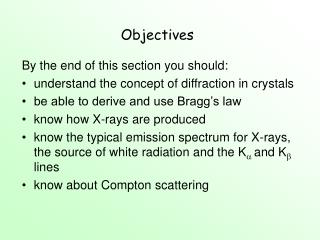
Objectives By the end of this section you should: • understand the concept of diffraction in crystals • be able to derive and use Bragg’s law • know how X-rays are produced • know the typical emission spectrum for X-rays, the source of white radiation and the K and K lines • know about Compton scattering
Diffraction - an optical grating Path difference XY between diffracted beams 1 and 2: sin = XY/a XY = a sin For 1 and 2 to be in phase and give constructive interference, XY = , 2, 3, 4…..n so a sin = n where n is the order of diffraction
Consequences: maximum value of for diffraction sin = 1 a = Realistically, sin <1 a > So separation must be same order as, but greater than, wavelength of light. Thus for diffraction from crystals: Interatomic distances 0.1 - 2 Å so = 0.1 - 2 Å X-rays, electrons, neutrons suitable
Beam 2 lags beam 1 by XYZ = 2d sin so 2d sin = nBragg’s Law
e.g. X-rays with wavelength 1.54Å are reflected from planes with d=1.2Å. Calculate the Bragg angle, , for constructive interference. = 1.54 x 10⁻¹⁰ m, d = 1.2 x 10⁻¹⁰ m, =? n=1 : = 39.9° n=2 : X (n/2d)>1 2d sin = n We normally set n=1 and adjust Miller indices, to give 2dhkl sin =
Use Bragg’s law and the d-spacing equation to solve a wide variety of problems 2d sin = n or 2dhkl sin =
Example of equivalence of the two forms of Bragg’s law: Calculate for =1.54 Å, cubic crystal, a=5Å 2d sin = n (1 0 0) reflection, d=5 Å n=1, =8.86o n=2, =17.93o n=3, =27.52o n=4, =38.02o n=5, =50.35o n=6, =67.52o no reflection for n7 (2 0 0) reflection, d=2.5 Å n=1, =17.93o n=2, =38.02o n=3, =67.52o no reflection for n4
Combining Bragg and d-spacing equation X-rays with wavelength 1.54 Å are “reflected” from the (1 1 0) planes of a cubic crystal with unit cell a = 6 Å. Calculate the Bragg angle, , for all orders of reflection, n. d = 4.24 Å
d = 4.24 Å n = 1 : = 10.46° n = 2 : = 21.30° n = 3 : = 33.01° n = 4 : = 46.59° n = 5 : = 65.23° = (1 1 0) = (2 2 0) = (3 3 0) = (4 4 0) = (5 5 0) 2dhkl sin =
X-rays and solids X-rays - electromagnetic waves So X-ray photon has E = h X-ray wavelengths vary from .01 - 10Å; those used in crystallography have frequencies 2-6 x 10¹⁸Hz Q. To what wavelength range does this frequency range correspond? c = max = 1.5 Å min = 0.5 Å
In the classical treatment, X-rays interact with electrons in an atom, causing them to oscillate with the X-ray beam. The electron then acts as a source of an electric field with the same frequency Electrons scatter X-rays with no frequency shift
Two processes lead to two forms of X-ray emission: Electrons stopped by target; kinetic energy converted to X-rays continuous spectrum of “white” radiation, with cut-off at short (according to h=½mv2) Wavelength not characteristic of target Incident electrons displace inner shell electrons, intershell electron transitions from outer shell to inner shell vacancy. “line” spectra Wavelength characteristic of target
Each element has a characteristic wavelength. For copper, the are: CuK1 = 1.540 Å CuK2 = 1.544 Å CuK = 1.39 Å Typical emission spectrum
Many intershell transitions can occur - the common transitions encountered are: 2p (L) - 1s (K), known as the K line 3p (M) - 1s (K), known as the K line (in fact K is a close doublet, associated with the two spin states of 2p electrons)
Copper K X-rays have a wavelength of 1.54 Å and are produced when an electron falls from the L shell to a vacant site in the K shell of a copper atom. Calculate the difference in the energy levels between the K and L shells of copper. E = h = c/ = (3 x10⁸) / (1.54 x 10⁻¹⁰) = 1.95 x 10¹⁸ Hz E = h = 6.626 x 10-34x 1.95 x 1018 = 1.29 x 10⁻¹⁵ J ~ 8 keV
Some radiation is also scattered, resulting in a loss of energy [and hence, E=h, shorter frequency and, c= , longer wavelength. The change in frequency/wavelength depends on the angle of scattering. This effect is known as Compton scattering It is a quantum effect - remember classically there should be no frequency shift
Calculate the maximum wavelength shift predicted from the Compton scattering equation. = 4.85 x 10⁻¹²m = 0.05Å
Filter As well as characteristic emission spectra, elements have characteristic absorptionwavelengths e.g. copper
We want to choose an element which absorbs K [and high energy/low white radiation] but transmits K e.g. Ni K absorption edge = 1.45 Å As a general rule use an element whose Z is one or two less than that of the emitting atom
Monochromator Choose a crystal (quartz, germanium etc.) with a strong reflection from one set of lattice planes, then orient the crystal at the Bragg angle for K1 = 1.540 Å = 2dhklsin
Example: A monochromator is made using the (111) planes of germanium, which is cubic, a=5.66Å. Calculate the angle at which it must be oriented to give CuK1 radiation d=3.27Å =2d sin = 13.62°
Summary • Crystals diffract radiation of a similar order of wavelength to the interatomic spacings • We model this diffraction by considering the “reflection” of radiation from planes - Bragg’s Law • X-rays are produced by intershell transitions - e.g. L-K (K) and M-K (K) • The interaction of X-rays with matter produces a small wavelength shift (Compton scattering) • Filters can be used to eliminate K radiation; monochromators are used to select K1 radiation.